




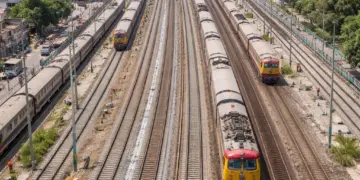
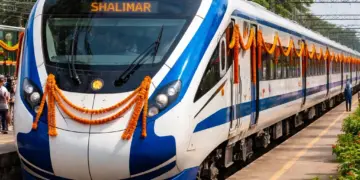


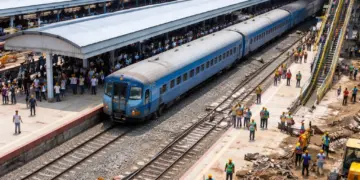
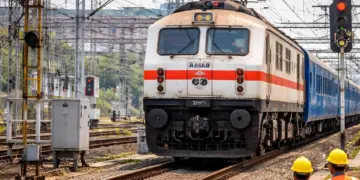






The Indian Railways has officially approved the construction of the third and fourth rail lines on the Dilkusha-Malhaur section to address the heavy traffic pressure on the Lucknow-Barabanki route. This expansion is part of a larger quadrupling project aimed at improving train punctuality and operational efficiency. Land leveling work has already commenced near Dilkusha as the department prepares for extensive track laying activities.
What are the key details and timelines for the Dilkusha-Malhaur project?
The Railway Board has sanctioned a budget of 159.68 crore for the 8.2 km stretch between Dilkusha and Malhaur. This specific section is expected to be completed by June 2028. For the adjacent Barabanki-Malhaur section, which covers 32.84 km, the target for completion is set for September 2026. Currently, land leveling for the Barabanki stretch is nearly 70 percent complete, and bridge construction is progressing steadily.
How will the project improve train operations on the Lucknow-Barabanki route?
This route is one of the busiest in the region, handling approximately 57 to 62 trains in each direction daily. The addition of the third and fourth lines will significantly reduce delays caused by bottlenecks. Once the entire project is operational by 2027-2028, it will provide dedicated tracks for different train categories, similar to the system used in major metropolitan cities. The following table highlights the current progress of the project segments:
| Section Name | Distance | Completion Target | Status |
|---|---|---|---|
| Dilkusha-Malhaur | 8.2 km | June 2028 | Work Started |
| Barabanki-Malhaur | 32.84 km | September 2026 | 70% Leveling Done |
| Overall Project | Lucknow-Barabanki | 2027-2028 | Ongoing |
While work between Malhaur and Dilkusha is gaining momentum, the demolition of bridge number 786 between Lucknow Charbagh and Dilkusha Cabin remains a critical task. Additionally, an overbridge at Pipraghat and the widening of Dilkusha Road are being undertaken to improve local traffic connectivity alongside the railway expansion.