




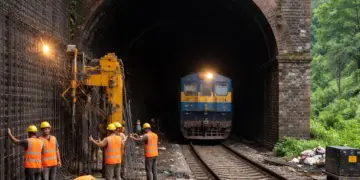














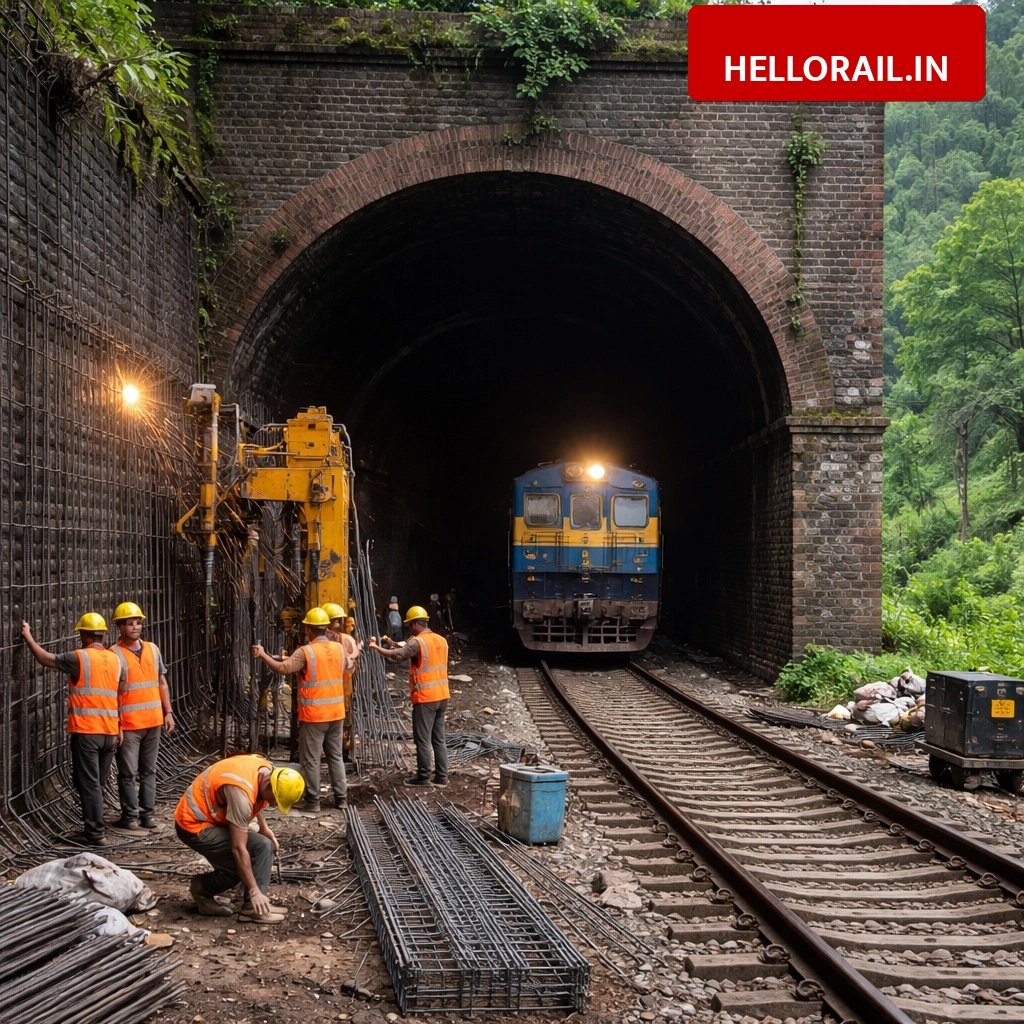

Indian Railways is working to strengthen and expand historical rail tunnels in the Gurpa-Gajhandi Ghat section. These tunnels were built during the British era about 120 years ago. The East Central Railway (ECR) is carrying out this work to allow larger coal-loaded BOBRN rakes to pass through the section without any hurdles.
ℹ️: Railway App Launch: Vijayawada Division introduces ‘Punctuality BZA’ for real-time train monitoring।
Why is the tunnel expansion necessary?
The Gurpa-Gajhandi Ghat section was built before independence and had limited clearance height. This made it difficult for BOBRN wagons to pass through due to structural obstructions. By redesigning and enlarging these tunnels, the railways will ensure the smooth movement of heavy coal rakes. This project is being done in collaboration with IIT-ISM Dhanbad to ensure technical accuracy.
What are the benefits of this project?
The expansion of these tunnels will directly impact the efficiency of coal transportation. The key benefits include:
- Faster wagon turnaround times for NTPC power plants at Barh and Barauni.
- Increased availability of rakes for freight movement.
- Higher overall loading volumes and better transportation efficiency.
Who is monitoring the progress?
East Central Railway General Manager Chhatrasal Singh has been closely monitoring the work. He conducted multiple footplate inspections in May and June 2026, including a review of coal-loaded BOBRN rake operations through three tunnels. Other key officials like Indu Rani Dubey and Akhilesh Mishra are also involved in overseeing the operational changes in the Dhanbad Division.
Frequently Asked Questions (FAQs)
Why is IIT-ISM Dhanbad involved in this project?
ECR collaborated with IIT-ISM Dhanbad for the technical redesign and dimensional enlargement of the tunnels to ensure they can safely accommodate BOBRN rakes.
Which power plants will benefit from this tunnel expansion?
The project will improve wagon turnaround times and increase coal supply efficiency for NTPC power plants located at Barh and Barauni.