





























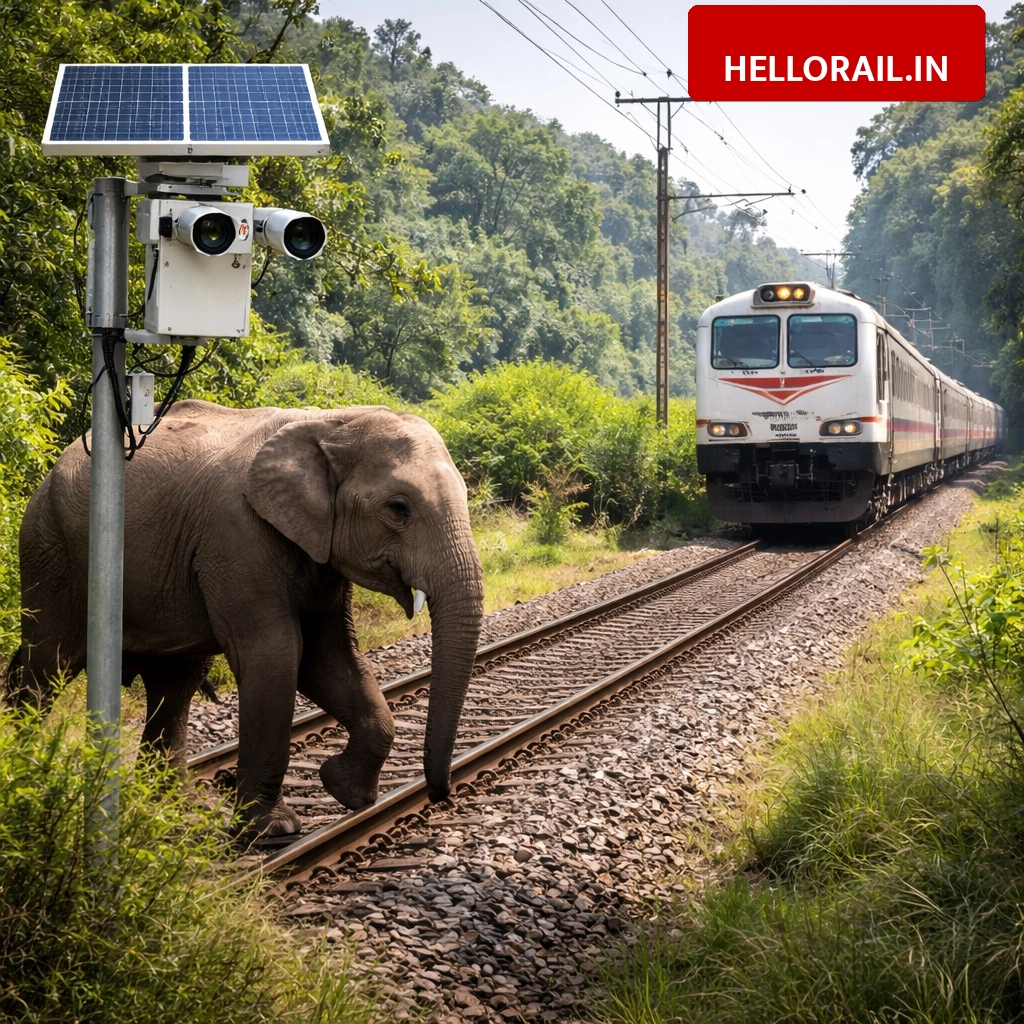

Indian Railways is implementing a high-tech mission to protect elephants and prevent train accidents in the Chakradharpur (CKP) Division of South Eastern Railway. The division will soon install an Artificial Intelligence (AI)-based Elephant Intrusion Detection System (EIDS) after successful trials. This system is developed in association with the Forest Department and the Ministry of Environment, Forest & Climate Change.
How does the AI detection system work?
The EIDS uses optical fibre and sensors to track elephant movements. It can detect elephants within a 30-meter radius on both sides of the track, specifically picking up movements at least 20 meters from the cable. Once detected, the system sends an immediate alert to the nearest station master. The station master then uses a wireless system to tell the loco pilot to slow down the train, while alerts are also sent to control rooms.
What are the project costs and coverage?
The AI system for the Chakradharpur division is being prepared with an estimated cost of Rs 15 crore. On a larger scale, Indian Railways has sanctioned this sensor-based system for 1,158 km of railway lines with a total budget of Rs 208 crore. The rollout is expanding to cover a total of 1,122 route kilometers across the network.
| Feature | Details |
|---|---|
| Trial Section | Barabamboo-Chakradharpur-Lotapahar |
| Detection Radius | 30 meters on both sides |
| CKP Division Cost | Rs 15 crore |
| Total Project Cost | Rs 208 crore |
| Total Sanctioned Length | 1,158 km |
| Testing Support | Vantara provided elephants Jyoti and Sonu |
Frequently Asked Questions (FAQs)
How does the system alert the train driver?
The AI system sends an alert to the station master, who then informs the loco pilot via wireless to slow down the train.
Which animals were used for the trials in Chakradharpur?
Vantara provided two elephants, Jyoti and Sonu, to test the system because elephant footstep signatures are unique.