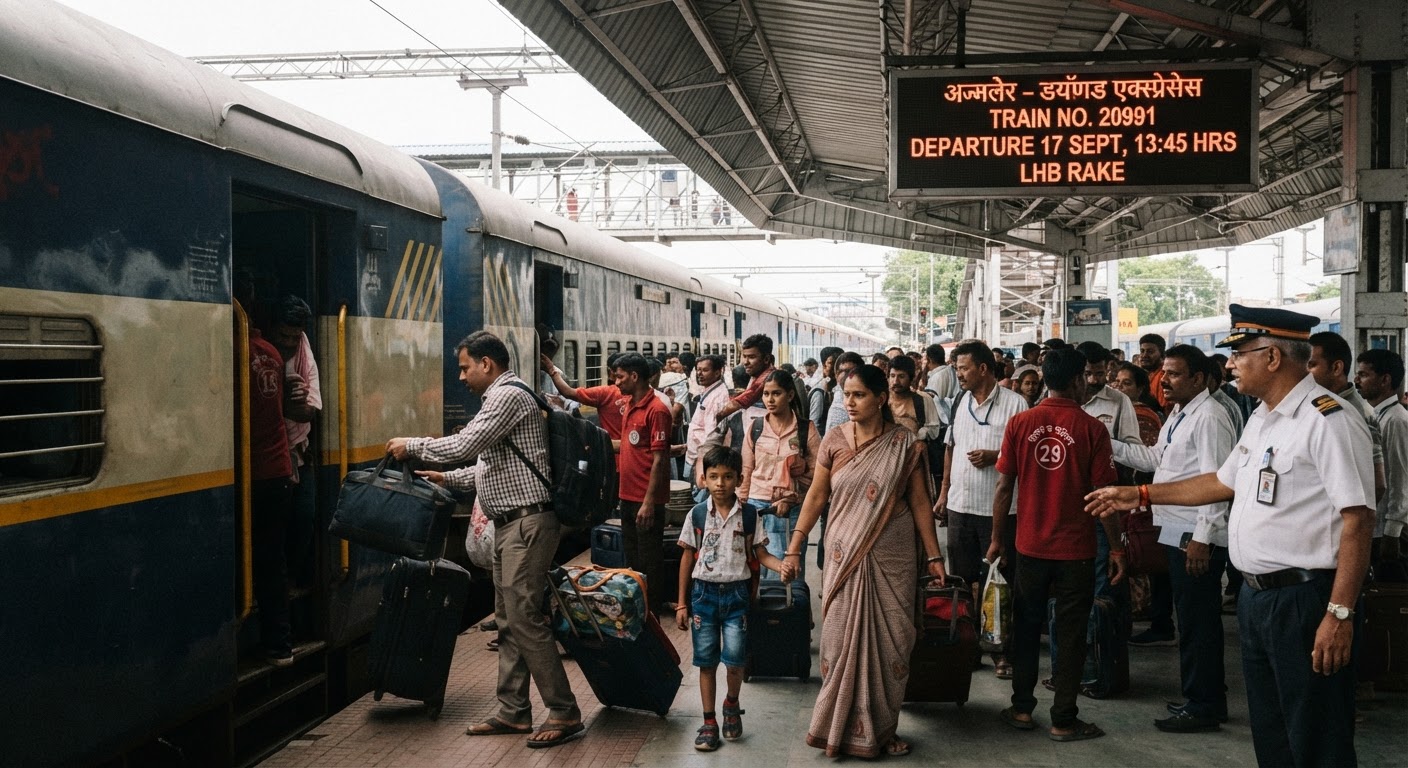
Indian Railways is upgrading the popular Ajmer-Daund Express to modern Linke-Hofmann-Busch (LHB) rakes to significantly enhance passenger comfort and safety. This major fleet upgrade applies to train numbers 20991 and 20992, bringing a smoother and more reliable travel experience for regular commuters and long-distance travellers alike. According to Shri Amit Sudarshan, Chief Public Relations Officer of North Western Railway, the transition to LHB rakes will officially take effect from September 17, 2026, for the service departing from Ajmer, and from September 18, 2026, for the train departing from Daund. Passengers travelling on this route can look forward to a modernised rake composition designed to meet growing travel demands efficiently.
The updated Ajmer-Daund Express will operate with a total of
19 modern LHB coaches. The revised coach configuration has been carefully structured to accommodate different classes of passengers comfortably. The train will feature
one Second AC coach,
six Third AC coaches,
five Sleeper class coaches,
five General class coaches, and
two Power Car coaches. This important fleet upgrade follows the successful recent regularization of the former special train service operating under numbers 09625 and 09626 into the permanent 20991 and 20992 Ajmer-Daund Express schedule.
LHB coaches are globally recognised and widely deployed across the Indian Railways network for their
superior safety features, higher speed potential, and enhanced passenger comfort compared to older traditional ICF coaches. One of the standout safety advantages of LHB coaches is their anti-telescopic design, which prevents coaches from climbing over each other during a collision or derailment. Additionally, these modern stainless-steel rakes are equipped with improved suspension systems for a jerk-free journey and feature better sound insulation to keep the interiors quieter. From an operational perspective, LHB coaches require
less frequent maintenance, which ensures greater punctuality, better operational efficiency, and higher reliability for the Ajmer-Daund route.