Bilaspur-Leh Rail: India to Build World's Highest Station
India plans a record-breaking railway station at 17,244 feet as part of the ₹1.31 lakh crore Bilaspur-Manali-Leh rail project.
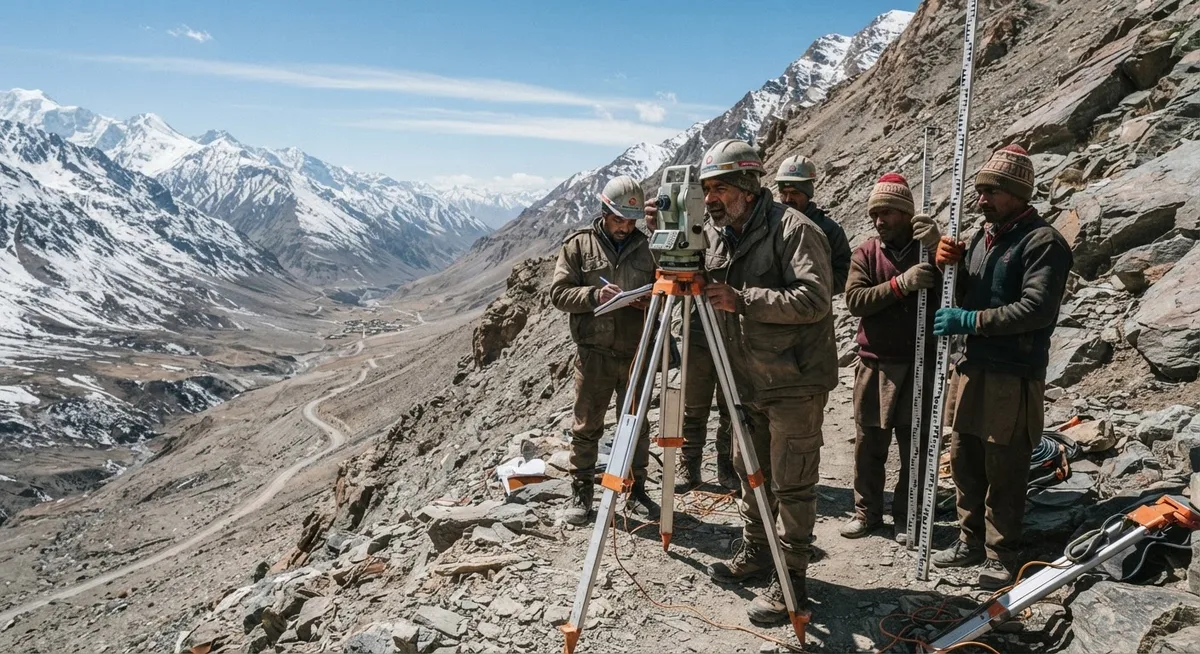
Indian Railways is preparing to undertake one of the most ambitious engineering feats in history. The Bilaspur-Manali-Leh rail project aims to establish the world’s highest railway station, a move that would redefine connectivity and logistics in the high-altitude regions of the Himalayas.
Breaking Records at Tanglang La
The centerpiece of this massive infrastructure undertaking is a proposed station located beneath the Tanglang La mountain pass. Situated at an incredible altitude of approximately 17,244 feet (5,256 meters), this station is designed to surpass the current record holder, China's Tanggula station, which stands at 5,068 meters.
Some engineering projections suggest the altitude could even reach as high as 17,582 feet, making it a true marvel of modern railway technology.
Project Scope and Strategic Importance
With an estimated cost of ₹1.31 lakh crore, the project is much more than a simple transport link; it is a strategic necessity. The 489-kilometer rail line is intended to bolster all-weather military logistics and enhance connectivity along India's sensitive northern borders.
Due to the extreme and complex Himalayan terrain, the project design requires massive tunneling work to ensure stability and connectivity:
- Total Line Length: 489 kilometers
- Tunneling Requirement: Approximately 270 kilometers
- Tunnel Percentage: Roughly 55% of the total route
The Proposed Route
The rail line will traverse several key regions, providing vital links between Himachal Pradesh and Ladakh. The proposed route includes the following locations:
- Bilaspur
- Sundernagar
- Mandi
- Manali
- Sissu
- Darcha
- Keylong
- Sarchu
- Pang
- Rumtse
- Upshi
- Kharu
- Leh
Engineering and Legal Challenges
Despite the grand vision, the project faces significant hurdles. While the Ministry of Defence considers this a priority, the environmental and administrative landscape is incredibly difficult.
Scientific experts from IIT Mandi have emphasized the necessity for rigorous geotechnical and cryospheric studies. These studies are crucial to mitigating risks associated with permafrost and the inherent geological instability of the Himalayan range.
Furthermore, administrative and legal complexities have surfaced. For instance, a recent Himachal Pradesh High Court ruling impacted related infrastructure, such as the Bhanupali-Bilaspur-Beri line, by quashing land acquisition notifications. Navigating these legal and environmental complexities remains a major task for the project's successful execution.