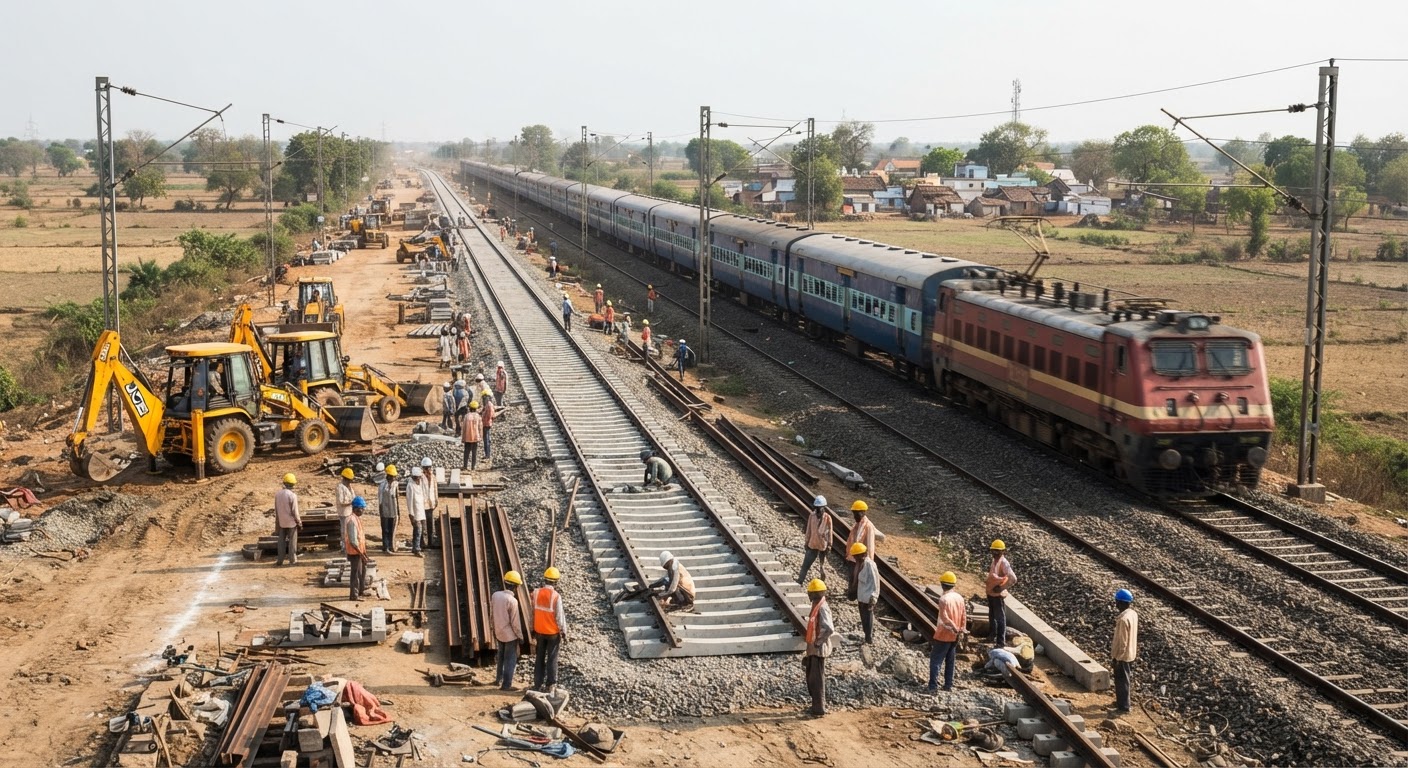
Indian Railways is taking a massive leap forward to transform train travel across the country by expanding its busiest corridors into four-track networks. This major infrastructure upgrade aims to resolve heavy congestion and significantly improve punctuality for daily commuters and freight transporters alike. Indian Railways is expanding 11,000 kilometers of its high-density rail network by four-laning tracks to ease severe congestion. This project addresses the operational disparity where 41% of India's total rail traffic is concentrated on just 16% of the network. Railway Minister Ashwini Vaishnaw stated that the expansion is driven by the vision of Prime Minister Narendra Modi to boost capacity for both passenger and freight movement across vital national corridors.
The ambitious expansion focuses on
seven high-density routes which include Delhi-Howrah, Delhi-Mumbai, Howrah-Chennai, Chennai-Mumbai, Delhi-Chennai, Mumbai-Howrah, and Delhi-Guwahati. These corridors are the backbone of the national infrastructure. For instance, the
Delhi-Howrah route covering approximately 1,400 km manages over 120 passenger and 100 freight trains daily. Similarly, the
1,500 km Delhi-Mumbai route serves over 90 passenger and 80 to 85 freight trains each day, with certain sections capable of supporting speeds up to 160 kmph. While some portions of this 11,000 km network already feature four tracks, construction is actively ongoing across larger stretches while remaining sections await Detailed Project Report approval.
Financial backing for these modernization efforts has grown significantly over the years.
The railway budget has risen sharply from Rs 32,000 crore in 2014-15 to Rs 2.78 lakh crore for the 2026-27 fiscal year. This record investment complements other major modernization achievements, such as railway electrification which reached
99.6% by July 2026. The network has also successfully integrated advanced rolling stock like Vande Bharat trains, Vande Bharat Sleeper services, and budget-friendly Amrit Bharat services. Furthermore, prioritizing passenger safety, the national transporter has commissioned
Kavach Version 4.0 across 2,633 route kilometers as of July 2026 to prevent collisions and ensure seamless train operations.