Indian Railways adopts hybrid annuity model to launch six new private freight lines
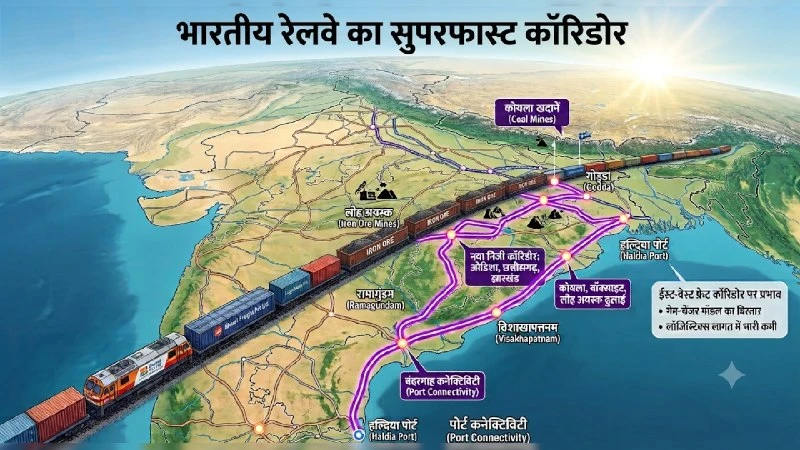
Indian Railways is taking a major step to strengthen the national logistics network by introducing six new freight lines spanning a total of 647 kilometers. This ambitious infrastructure expansion aims to bolster the East-West Freight Corridor and reduce logistics costs across the country. The Public Private Partnership Appraisal Committee under the Ministry of Finance officially approved these projects in August 2026. For the first time, Indian Railways will utilize the Hybrid Annuity Model, a popular financing structure previously used primarily in the highway sector. The initiative is designed to attract private investment while ensuring the government retains full control over train operations and freight revenue. Passengers and industry stakeholders can look forward to a more efficient freight movement system that supports key industrial sectors.
Key highlights of the new freight lines project include:
- Six new freight routes spanning 647 kilometers across Odisha, Telangana, and Jharkhand.
- First-ever implementation of the Hybrid Annuity Model in Indian Railways, approved in August 2026.
- Total estimated bid cost of ₹15,976 crore with a total capital expenditure projected at ₹40,866 crore.
- Financial structure involves a 40 percent construction-phase grant by Indian Railways and 60 percent financing by private partners.
- Government retains all tariff and traffic risks alongside full control over train operations and revenue collection.
- Scheduled tender process in the 2027-28 financial year with construction starting in April 2028.
Understanding the Hybrid Annuity Model Financing Structure
The financial framework of this project represents a novel approach for Indian Railways. The total estimated bid cost stands at ₹15,976 crore, while the overall capital expenditure is projected to reach ₹40,866 crore over a concession period spanning 17 to 19 years. Under the Hybrid Annuity Model framework, Indian Railways will provide 40% of the bid project cost as a construction-phase grant. Meanwhile, private partners will finance the remaining 60%. Once these lines become operational, Indian Railways will repay the private entity through interest-bearing annuities while simultaneously covering maintenance costs. Crucially, the government will retain all tariff and traffic risks, ensuring that authorities maintain full control over train operations and freight revenue collection.
Specific Routes and Regional Benefits
The comprehensive development plan covers six specific routes distributed across three states. In Odisha, four crucial lines are planned: the 49.58-km Balaram-Putgadia-Tentuloi Inner Corridor, the 112.56-km Budhapank-Tentuloi-Luburi Outer Corridor, the 101.26-km Jajpur-Keonjhar Road-Aradi-Dhamara Port line, and the 48.96-km Tikiri Station to Waltair Bauxite Mines line. Additionally, Telangana will witness the construction of the 207.80-km Manuguru-Ramagundam line, and Jharkhand will benefit from the 126.52-km Pakur/Nagarnabi to Godda line. These designated routes are primarily intended to facilitate the bulk transport of essential commodities, including coal, iron ore, bauxite, coke, chemical manure, cement, and food grains, thereby boosting regional industrial growth.
Project Timeline and Broader Infrastructure Goals
The projects are currently awaiting final clearance from the Union Cabinet. Following this approval, the official tender process is scheduled to take place during the 2027-28 financial year, with physical construction expected to commence in April 2028. This upcoming expansion seamlessly complements broader railway infrastructure efforts currently underway. These efforts include the development of seven high-density, four-track routes covering 11,000 km and the ongoing advancement of the 2,052-km East-West Dedicated Freight Corridor stretching from Dankuni in West Bengal to Surat in Gujarat.