Mumbai-Ahmedabad Bullet Train: Massive Vadodara Portal Beams Completed
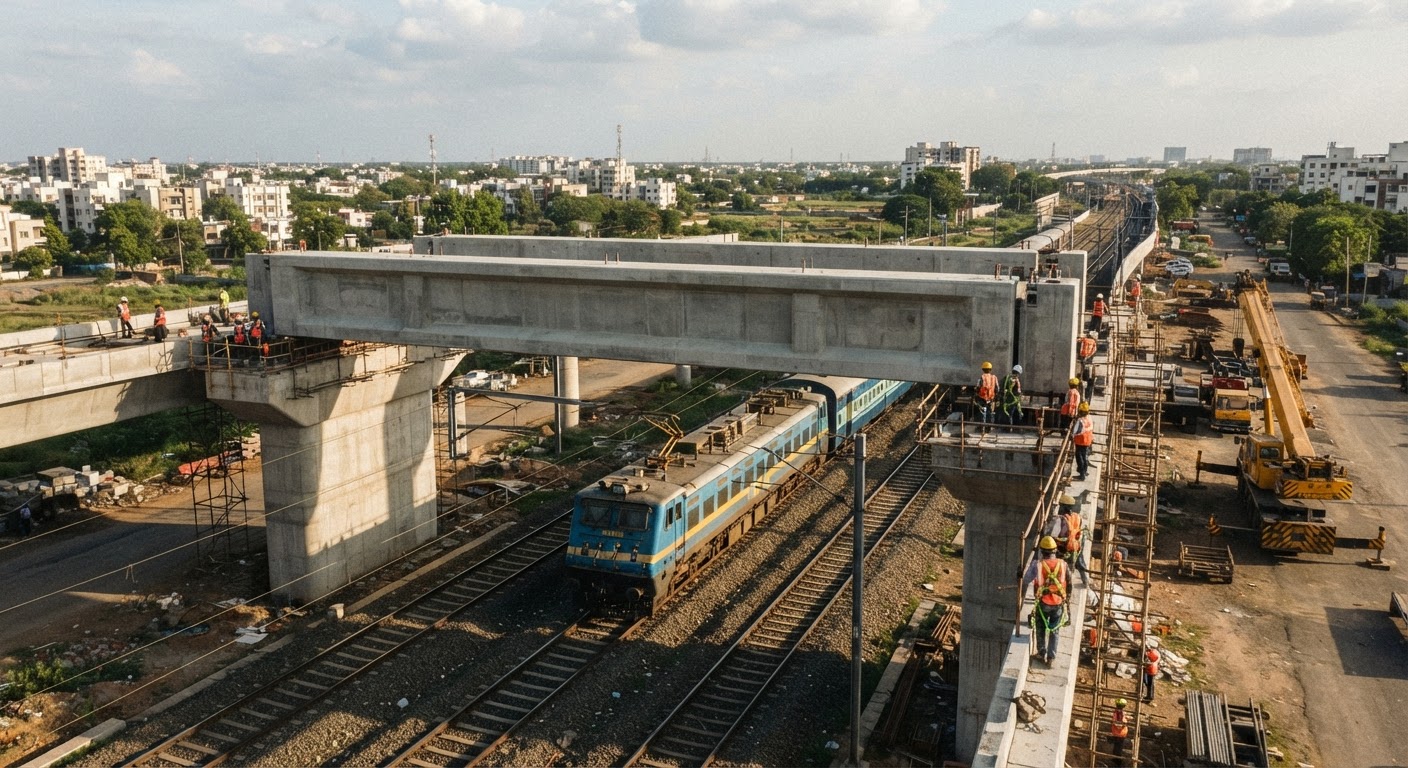
The National High Speed Rail Corporation Limited (NHSRCL) has achieved a significant engineering milestone in the Mumbai Ahmedabad Bullet Train Vadodara section. On October 12, 2026, the construction team successfully completed all 14 portal beams positioned over the busy Delhi-Mumbai Rajdhani main line.
These massive concrete structures are essential for the next phase of the 508-kilometre high-speed rail corridor, as they will support the elevated viaduct while allowing existing train services to continue running without interruption.
Overcoming Complex Engineering Constraints
Constructing these beams was a major technical challenge. Due to the extremely tight spaces available above the active railway tracks, engineers found that conventional precast launching methods were unfeasible. To manage this, the NHSRCL team opted for cast in situ construction, building the structures directly on-site to navigate the spatial limitations.
The Massive Scale of the Portal Beams
The sheer size and weight of these structures highlight the complexity of the project. Each individual beam is a feat of modern engineering:
- Weight: Approximately 1,500 tonnes per beam.
- Dimensions: 37 metres in length, 4 metres in width, and 4 metres in height.
- Material Requirements: Each beam requires roughly 590 cubic metres of concrete and a massive 55-tonne reinforcement steel cage.
Strategic Installation Across Vadodara
The construction teams distributed these 14 installations across two specific segments within the urban stretch to ensure precision and safety. The breakdown of the beam placement is as follows:
- 10 beams: Located between the Vadodara bullet train station and the Vishwamitri railway station.
- 4 beams: Located between the Vadodara railway station and the Chhayapuri railway station.
To integrate this work with ongoing Indian Railways operations, engineers utilized high-capacity cranes, long boom concrete pumps, and rigorous precision surveying to ensure no disruption to the Rajdhani line.
Looking Ahead: 2027 Launch and Full Corridor Completion
This accomplishment clears a major structural hurdle, allowing the team to begin launching 40-metre composite girders over the Rajdhani line using span-by-span methods. This progress moves the project closer to its ambitious timelines.
The project, with an estimated cost between ₹1.98 and ₹2 lakh crore, is being developed with significant technical and financial support from the Japan International Cooperation Agency (JICA).
According to Railway Minister Ashwini Vaishnaw, the first operational section of the high-speed rail is expected to launch near Surat and Bilimora in 2027. The goal is to have the full corridor operational through phased openings by approximately 2029. Once completed, the bullet train is expected to connect the major hubs in just about 2 hours, providing a massive boost to regional logistics and connectivity in Gujarat and Maharashtra.