Prime Minister Narendra Modi dedicates final western freight corridor link to jnpt port
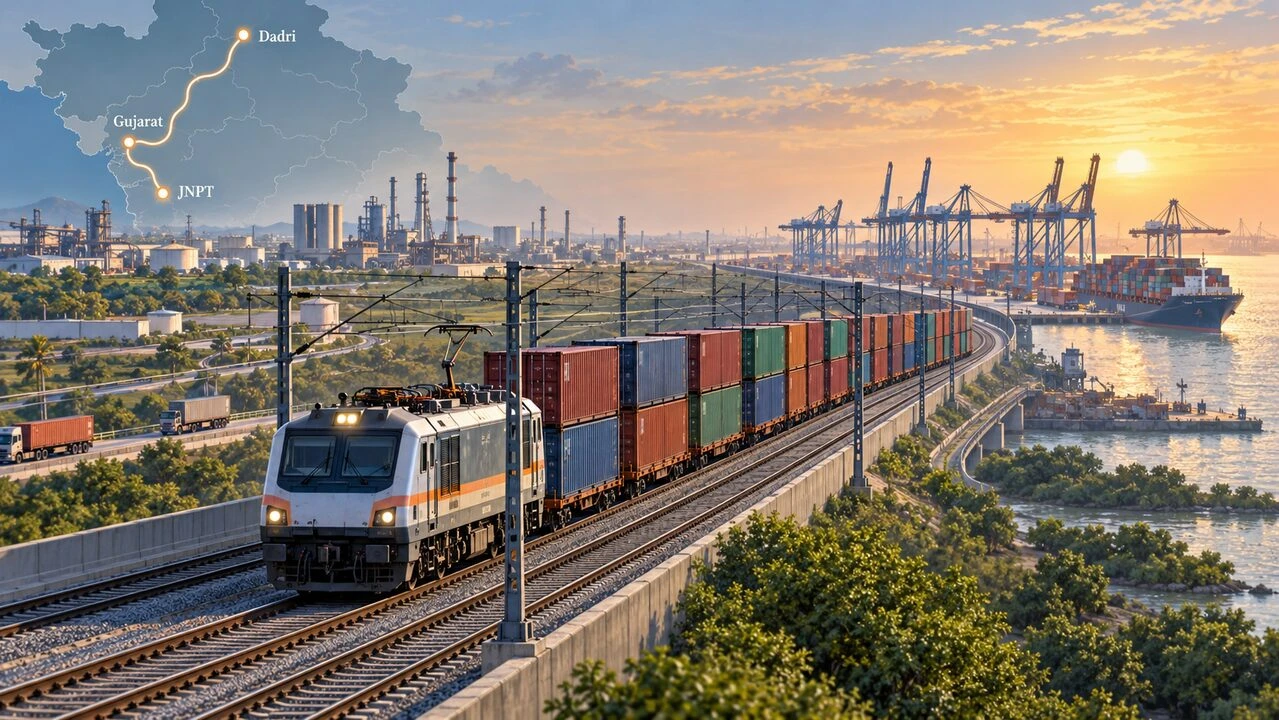
Prime Minister Narendra Modi is scheduled to dedicate three major sections of the Western Dedicated Freight Corridor on September 8 to complete the full operational network of the line. This massive expansion marks a critical shift for the national logistics sector by connecting India's largest container port at Jawaharlal Nehru Port directly to a high-capacity electric railway path. The Prime Minister's Office announced on September 7 that these developments form part of a broader infrastructure package valued at over ₹35,000 crore. The three specific freight corridor segments being commissioned include the Sanand North to Makarpura, New Umbergaon to New Saphale, and New Saphale to JNPT routes spanning 326 route kilometres with an investment exceeding ₹20,700 crore. Beyond the freight corridor, the government is initiating several other projects including the new Jobat to Tanda Road line to support remote tribal areas and various passenger rail services. Foundations are also being laid for three additional rail projects covering 329 kilometres with a budget of more than ₹9,700 crore, featuring work on the Vadodara to Ratlam lines, the Miyagam Karjan to Choranda to Malsar gauge conversion, and the Vishwamitri to Dabhoi project. Additionally, the package incorporates three national highway projects costing approximately ₹1,780 crore and Gujarat government initiatives valued at about ₹2,600 crore, featuring a 110 MW floating solar project at Kadana Dam alongside urban water and housing works.
Strategic Importance for National Logistics
Standard Indian rail infrastructure historically forces freight and passenger trains to compete for the exact same tracks, leading to severe congestion and slower movement. The Dedicated Freight Corridor Corporation of India Limited describes the Western corridor as a 1,504 kilometre double-line electrified track running through major industrial hubs like Vadodara, Ahmedabad, Palanpur, Phulera, and Rewari. Segregating freight traffic is specifically designed to allow for heavier axle loads, longer trains, and much more consistent transit times across the network. Reliability serves as a core goal of this major operational shift. Exporters typically plan their production schedules and container stuffing around specific vessel cut-off times. Removing the variability caused by passenger train priority allows manufacturing and logistics firms to potentially reduce their buffer inventory significantly.
Addressing the Last Mile Challenge
A dedicated railway trunk line does not automatically solve every cost challenge present in the supply chain. While electric rail offers significant efficiency for dense freight flows, many containers still require final truck transport to reach inland terminals or factory gates. Performance remains heavily dependent on several critical variables existing outside the corridor itself. These crucial factors include port dwell times, terminal access, train scheduling, and the overall efficiency of empty container repositioning. Real evaluation of these logistics gains requires a lane-specific analysis where stakeholders must track median and 90th-percentile door-to-port times, total shipper prices, and the ultimate share of freight shifting successfully from road to rail.
Looking Ahead at Performance Metrics
The coming months will determine how effectively the wider industry adopts this vital new infrastructure. Success will be strictly measured by daily train counts, average freight loads, and the ability to consistently maintain services against existing trucking and mixed-use rail options. Questions naturally remain regarding opening-day frequency, end-to-end tariffs, and specific volume commitments from major industrial players. A joint monthly corridor scorecard issued by the JNPA, the Dedicated Freight Corridor Corporation of India, and Indian Railways could help clarify these important operational outcomes going forward.