Spain Tragedy: 68 Dead in High-Speed Train Collision Near Toledo
A catastrophic high-speed train collision near Toledo, Spain, has left 68 dead. Investigations point to a major rail control center error.
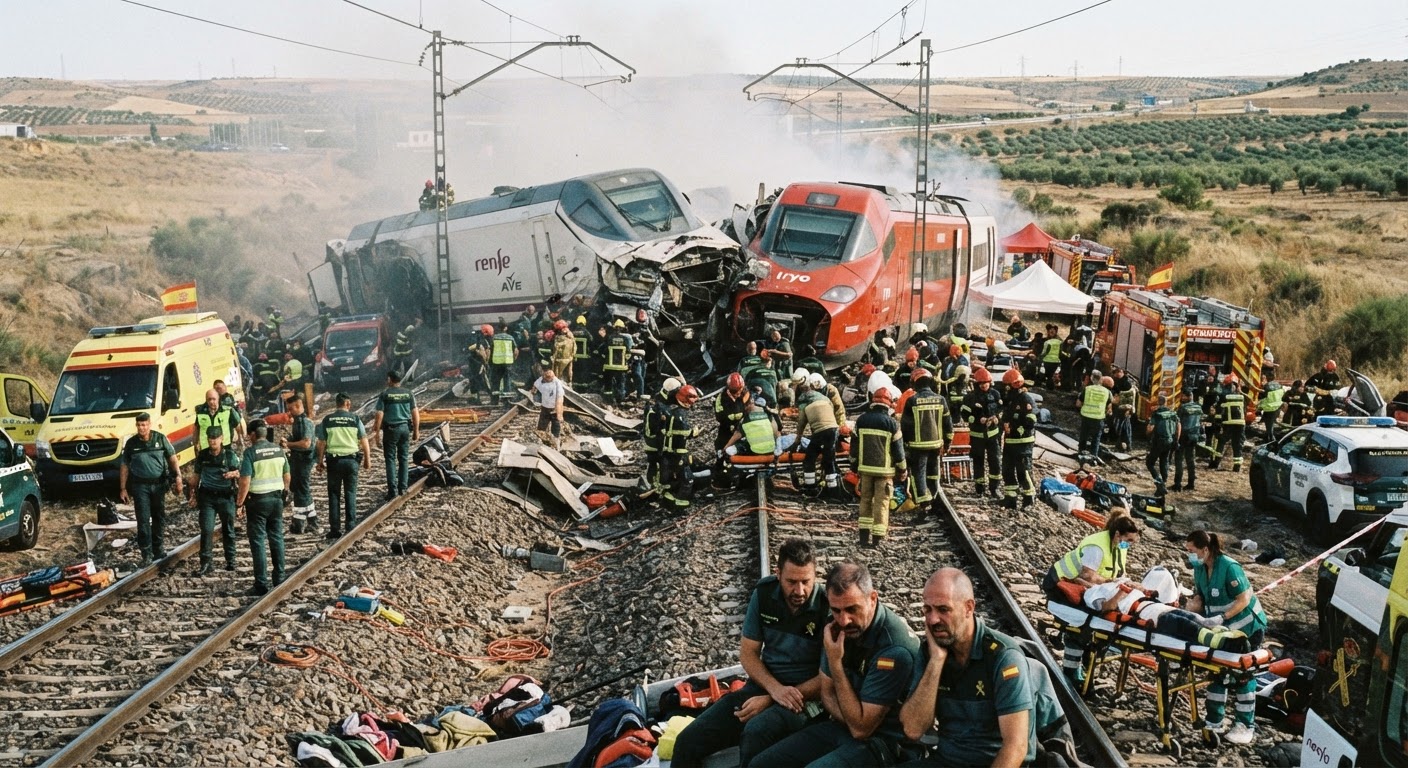
A catastrophic rail disaster has struck central Spain, leaving the nation in mourning after a high-speed train collision claimed at least 68 lives. The accident occurred on Wednesday, October 28, 2026, near Urda in the Toledo province, when a Renfe AVE train collided with a stationary Iryo train.
The Moment of Impact
The collision took place at approximately 8:53 AM local time at kilometer 118 on the Madrid-Seville high-speed line. The Renfe train was carrying 397 passengers at the time of the impact, while the stationary Iryo train was transporting 147 passengers, including an infant.
Among the confirmed fatalities is 24-year-old long jumper Julieta Gallego. Emergency services, including over 500 personnel from the Civil Guard and Civil Protection, were immediately deployed to the site for rescue and recovery operations. Currently, approximately 50 individuals remain seriously injured, with 15 reported to be in critical condition at local hospitals.
A Fatal Command: The Investigation Begins
Spain’s Transportation Minister, Óscar Puente, has described the crash as the result of an "inexplicable" order issued by a rail control center. Preliminary findings suggest a significant technical and human error led to the tragedy.
- System Failure: At 8:30 AM, a computer malfunction disabled the LZB safety system across a 63-kilometer stretch.
- Protocol Breach: Standard safety protocols mandate that all trains stop or proceed at strictly restricted speeds during such a failure.
- The Error: Despite the malfunction, the Renfe train was authorized to resume travel under "normal running" conditions without speed restrictions.
Minister Puente emphasized that the train engineers were not at fault, labeling the control center's decision as "clearly a wrong decision." Railway engineering expert Ramiro Aurin echoed these sentiments, noting that human error in the control center is the most probable cause.
Safety Concerns and National Mourning
This disaster marks the second major rail accident in Spain within just nine months, following a crash near Adamuz in January that killed 46 people on the same line. The incident has reignited a fierce debate over the country's rail infrastructure priorities.
"Spain is mourning today," stated Prime Minister Pedro Sánchez, who pledged a thorough investigation into the oversight.
Data from 2018 to 2022 reveals a concerning trend: only 16% of the average annual investment in Spain's high-speed rail network was dedicated to maintenance and upgrades, raising questions about whether network expansion has come at the cost of passenger safety.
Current Status of Rail Services
As the Civil Guard continues its investigation into Adif's control center operations, rail services between Madrid, Ciudad Real, and Andalusia remain suspended. The Spanish government has declared three days of national mourning, lasting from October 29 through October 31.