Indian Railways successfully transports live human heart via Vande Bharat Express
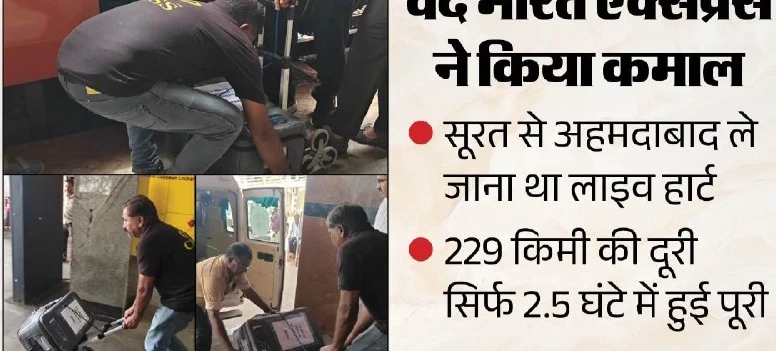
Indian Railways achieved a historic medical milestone on July 31, 2026, by successfully transporting a live human heart from Surat to Ahmedabad using the Vande Bharat Express. This mission marks the first time in Indian history that a live organ has been transported via train, showcasing the network’s potential to support critical emergency healthcare services. The operation was completed in approximately two and a half hours, proving the reliability of the rail network in time-sensitive medical scenarios.
- Train Number: 20901 (Mumbai Central–Gandhinagar Capital Vande Bharat Express).
- Date of Operation: July 31, 2026.
- Route: Surat to Ahmedabad.
- Duration: Approximately 2.5 hours.
- Key Partners: Indian Railways, RPF, Gujarat State Police, and medical teams.
A New Standard for Emergency Logistics
The life-saving transport was executed on the Mumbai Central–Gandhinagar Capital Vande Bharat Express. Divisional Railway Manager (DRM) Ved Prakash hailed the event as a moment of immense pride for the organization. He emphasized that in medical emergencies, every second is vital, and the seamless coordination between the railway staff, the Railway Protection Force (RPF), and state authorities was the key to this success.
Upon the train’s arrival at Ahmedabad station, the RPF and Gujarat State Police worked in tandem to establish a dedicated ‘green corridor’. This cleared path allowed for the rapid transit of the organ from Platform Number 1 directly to the U.N. Mehta Institute of Cardiology & Research Center, where the transplant surgery was waiting to commence.
Why Vande Bharat is a Game Changer
This successful mission highlights a significant shift in how India approaches medical logistics. While air transport is often the default for organ transfers, the speed, punctuality, and logistical convenience of the Vande Bharat Express offer a highly reliable and efficient alternative. By integrating these high-speed trains into emergency healthcare chains, Indian Railways is reinforcing its commitment to social responsibility and humanity. This milestone demonstrates that the modern railway infrastructure is capable of far more than just passenger transport, effectively stepping into the role of a critical life-saving partner for the nation.