






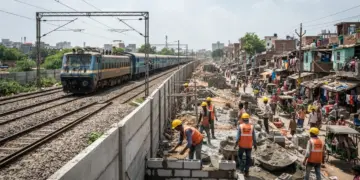





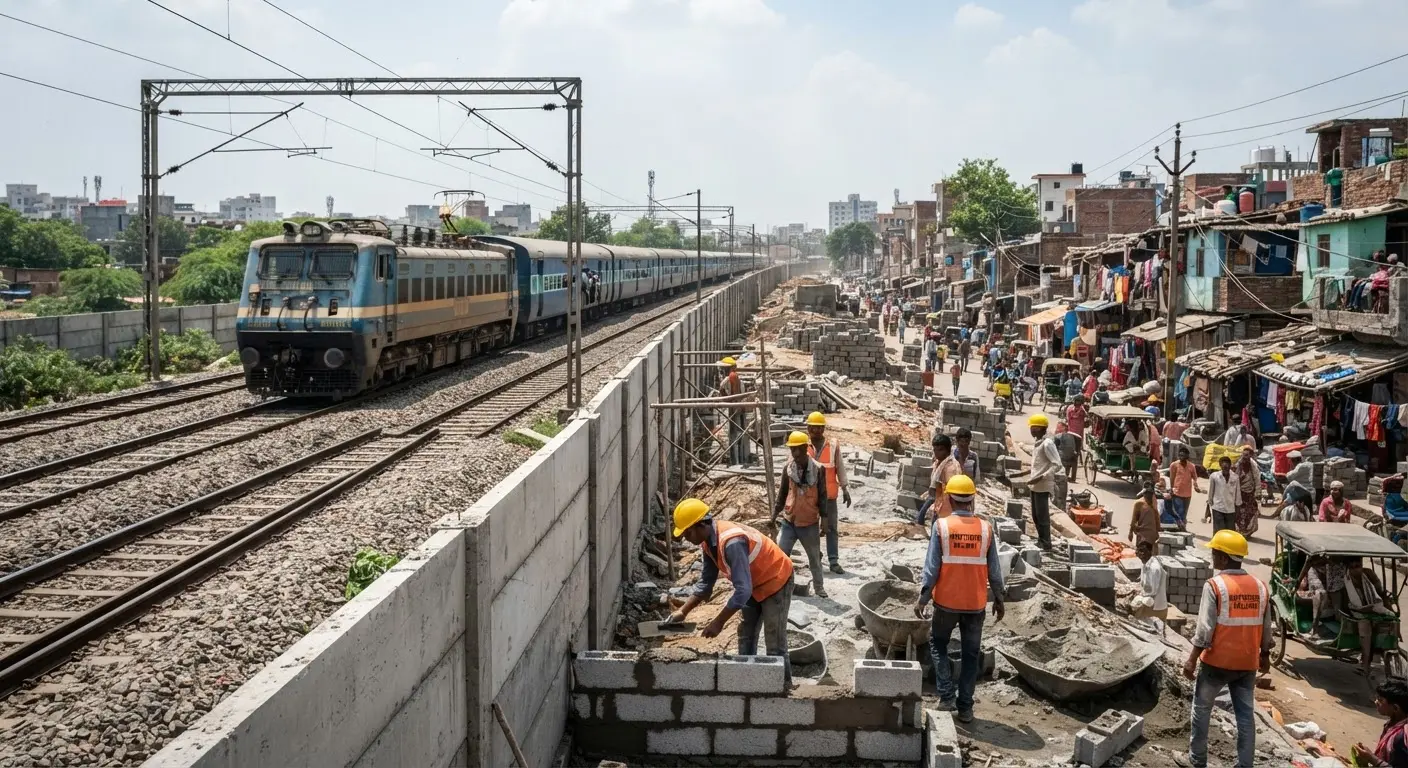

Northern Railway has launched a major initiative to secure railway land across Delhi and the surrounding National Capital Region by constructing boundary walls. As of August 20, 2026, tenders have officially been issued to facilitate this construction, prioritizing densely populated areas near markets and residential settlements that face a high risk of encroachment. This proactive measure aims to permanently prevent the re-encroachment of land following previous demolition efforts.
Northern Railway is taking this step to protect valuable public property from illegal occupation. According to data reported to the Rajya Sabha by Railway Minister Ashwini Vaishnaw on March 30, 2026, approximately 1,068 hectares—about 0.21 percent of the total 4.99 lakh hectares of railway land—remained under illegal occupation. Further data from a July 2026 RTI filing revealed that railway land encroachment had increased by 32 percent over the preceding five years, with 1,068.54 hectares reported as encroached by March 2025.
Technology and Humanitarian Approaches
To combat these ongoing issues, Indian Railways has implemented advanced technology-based monitoring systems. These include drone surveys, satellite imagery, and artificial intelligence. While enforcement remains active—as demonstrated by the July 11, 2026, clearance drive near the Zakhira area of Moti Nagar in Delhi—the government emphasizes a humanitarian approach to land clearance. This includes utilizing the Surat model, where displaced individuals are provided housing under the PM Awas Yojana.
Enhancing Passenger Safety and Preventing Trespassing
Beyond property protection, the construction of boundary walls is part of a nationwide effort to prevent trespassing and significantly improve train safety. As of August 12, 2026, Indian Railways had installed roughly 19,700 kilometers of safety fencing across the network. Notable progress includes work nearing completion on the Delhi-Prayagraj route, alongside finished sections extending from Delhi through Mathura toward Jhansi as of June 26, 2026. These security and fencing efforts also strictly address unauthorized track crossings, which resulted in legal action against 973 individuals across 20 railway stations in the six months leading up to June 26, 2026.