

















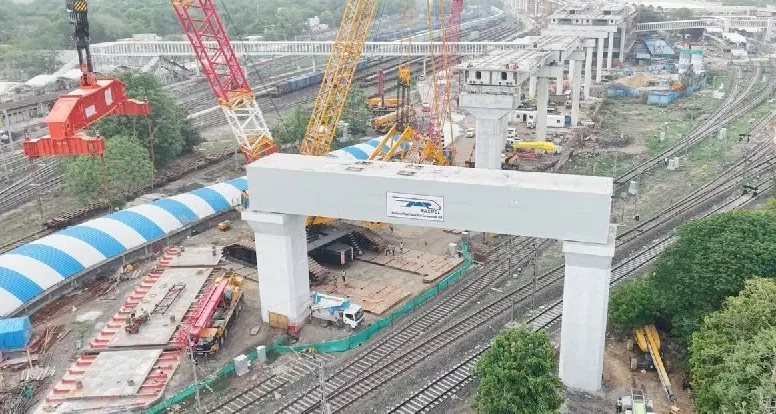

India’s ambitious high-speed rail network took a giant leap forward on July 10, 2026, as the National High-Speed Rail Corporation Limited (NHSRCL) celebrated a dual success in both Ahmedabad and Mumbai. These developments mark a pivotal moment for the Mumbai-Ahmedabad bullet train corridor, bringing the nation closer to its high-speed rail dream.
Key updates from the project include:
• Successful completion of all 13 heavy portal beam launches in Ahmedabad.
• Inauguration of the first Tunnel Boring Machine (TBM) operation in Mumbai by Railway Minister Ashwini Vaishnaw.
• Commencement of excavation from Vikhroli towards the Bandra Kurla Complex (BKC).
• Strategic deployment of customized German-made TBMs for the 20.37-kilometer underground tunnel stretch.
Progress in Mumbai and Ahmedabad
The completion of the 13 heavy portal beams in Ahmedabad provides the essential structural foundation for the elevated corridor. Simultaneously, the focus shifted to the complex underground work in Mumbai. The newly launched TBM is currently positioned 56.6 meters below ground level at Vikhroli. This engineering marvel is designed as a single-tube structure that will house twin tracks at an approximate depth of 65 meters, showcasing the scale and precision of the project.
Engineering the Underwater Stretch
To navigate the challenging terrain, NHSRCL is utilizing two customized German-designed TBMs, which were brought into operation after being imported in March 2026. These machines are tasked with carving out a 20.37-kilometer tunnel, a critical segment that includes a seven-kilometer undersea stretch. According to project timelines, each TBM is expected to excavate roughly 300 meters per month. Once both machines are fully operational, the project expects a combined excavation speed of 600 meters per month.
Looking Ahead
The Ministry of Railways remains focused on its immediate targets to ensure the project stays on track. While the underground tunnel work in Mumbai is a long-term engineering feat, the government has set a firm deadline to operationalize the 47-kilometer priority corridor between Surat and Bilimora by August 2027. As construction accelerates, these milestones represent the growing capability of Indian infrastructure to deliver world-class high-speed rail connectivity.