













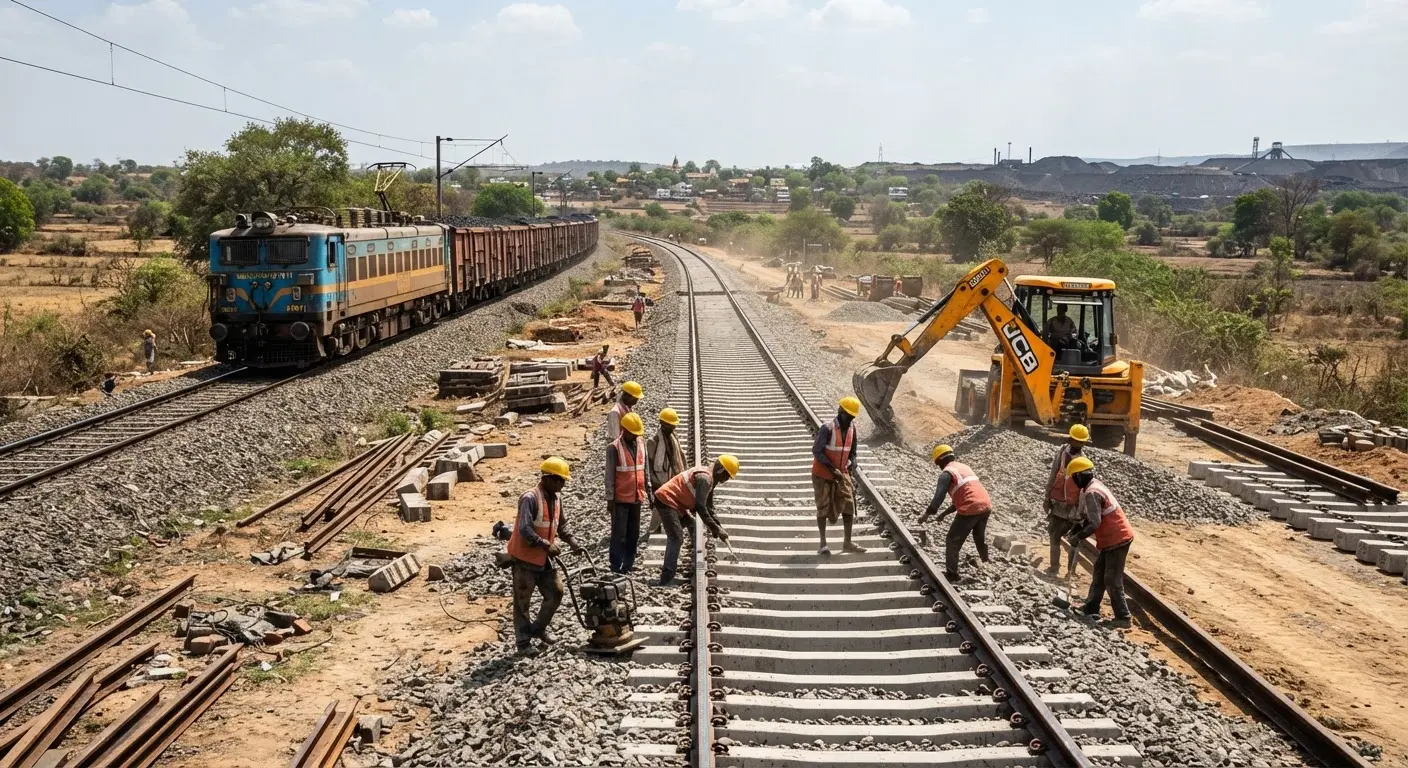

Indian Railways has officially approved a significant infrastructure investment of ₹228 crore aimed at doubling the 14-kilometer Tadali-Ghugus rail section in Maharashtra. This strategic development is designed to strengthen the Delhi-Chennai High-Density Network (HDN), a vital artery for the nation’s logistics and freight movement. By removing critical bottlenecks, the project ensures smoother operations and higher efficiency along this busy route.
- Investment: ₹228 crore approved for the 14-km Tadali-Ghugus doubling project.
- Strategic Location: Located on the Wardha-Balharshah line, a key part of the Delhi-Chennai HDN.
- Capacity Boost: Expected increase of 4.5 million tonnes per annum (MTPA) in freight capacity.
- Goal: To facilitate simultaneous train movements and reduce network congestion.
Enhancing Network Fluidity
Currently, the Tadali-Ghugus section operates as a single-line segment, which often leads to operational delays and capacity constraints. By converting this stretch into a double-line, Indian Railways will enable simultaneous train movements in both directions. This upgrade is a major step in the Ministry of Railways’ broader mission to modernize the national network through various doubling, trebling, and quadrupling projects.
The Delhi-Chennai HDN is essential for the movement of critical industrial commodities, including coal, iron ore, gypsum, petroleum products (POL), sand, and laterite ash. The addition of 4.5 MTPA in freight-carrying capacity will play a pivotal role in meeting the rising demand for bulk commodity transportation across the country.
Supporting Industrial Growth
Beyond simply reducing congestion, the upgraded infrastructure is set to streamline the supply chain for raw materials and finished goods. By improving network fluidity, Indian Railways is directly supporting industrial growth and economic activity along the corridor. This project reflects a focused approach to enhancing the reliability of the rail network, ensuring that the heavy traffic on the Delhi-Chennai artery can be managed more effectively in the coming years.