











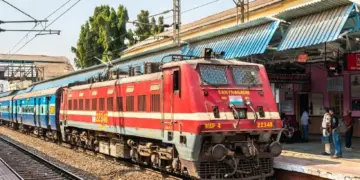



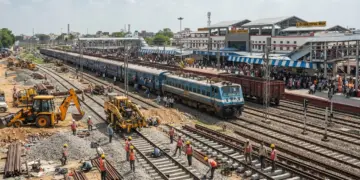



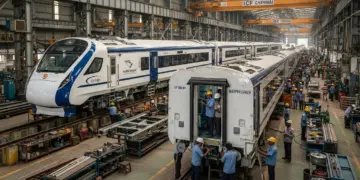



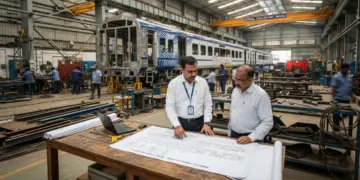






Indian Railways is significantly scaling up its infrastructure to streamline logistics and bolster national freight earnings. With a strategic investment of ₹3,300 crore, the national transporter is focusing on enhancing connectivity to the Paradip Port in Odisha. This initiative, which includes laying 98 kilometers of new rail lines and augmenting capacity on the Cuttack and Haridaspur routes, aims to drastically reduce transit times for cargo and improve the efficiency of supply chains.
Key highlights of the infrastructure push include:
- Investment of ₹3,300 crore dedicated to port connectivity and freight infrastructure.
- Construction of 98 kilometers of new rail lines to improve access to Paradip Port.
- A ₹2,500 crore project for the 74-kilometer doubling of the Paradip-Haridaspur section.
- Alignment with ‘Mission 3000’ to achieve 3,000 metric tonnes of freight loading by 2030-31.
- Targeting a record freight revenue of ₹1.89 lakh crore for the 2026-27 fiscal year.
Strategic Growth and Revenue Targets
This expansion is a direct follow-up to the Union Cabinet’s July 2026 approval of the Paradip-Haridaspur doubling project. By modernizing these critical routes, Indian Railways is positioning itself to handle higher volumes of cargo more efficiently. The ministry is also actively pursuing eight structural reforms under the ‘Reform Express’ initiative to modernize logistics operations across the country.
Financially, the stakes are high. Having moved a record 1.67 billion tonnes of freight in FY 2025-26, the Railways is targeting an increase to 1.76 billion tonnes in the current fiscal year. This growth is expected to drive a 5.8% increase in revenue, moving from ₹1.78 lakh crore in the previous year to a target of ₹1.89 lakh crore for FY 2026-27.
Success of the Gati Shakti Policy
Beyond direct infrastructure spending, the Gati Shakti Multi-Modal Cargo Terminal (GCT) policy has emerged as a major catalyst for growth. The policy has successfully attracted ₹10,000 crore in private investment. To date, 142 terminals are fully operational, providing a combined annual handling capacity of 224 million tonnes. With the Paradip Port alone handling 156.45 million tonnes of cargo in the last fiscal year, these upgrades are essential to maintaining the momentum of India’s industrial and economic growth.