





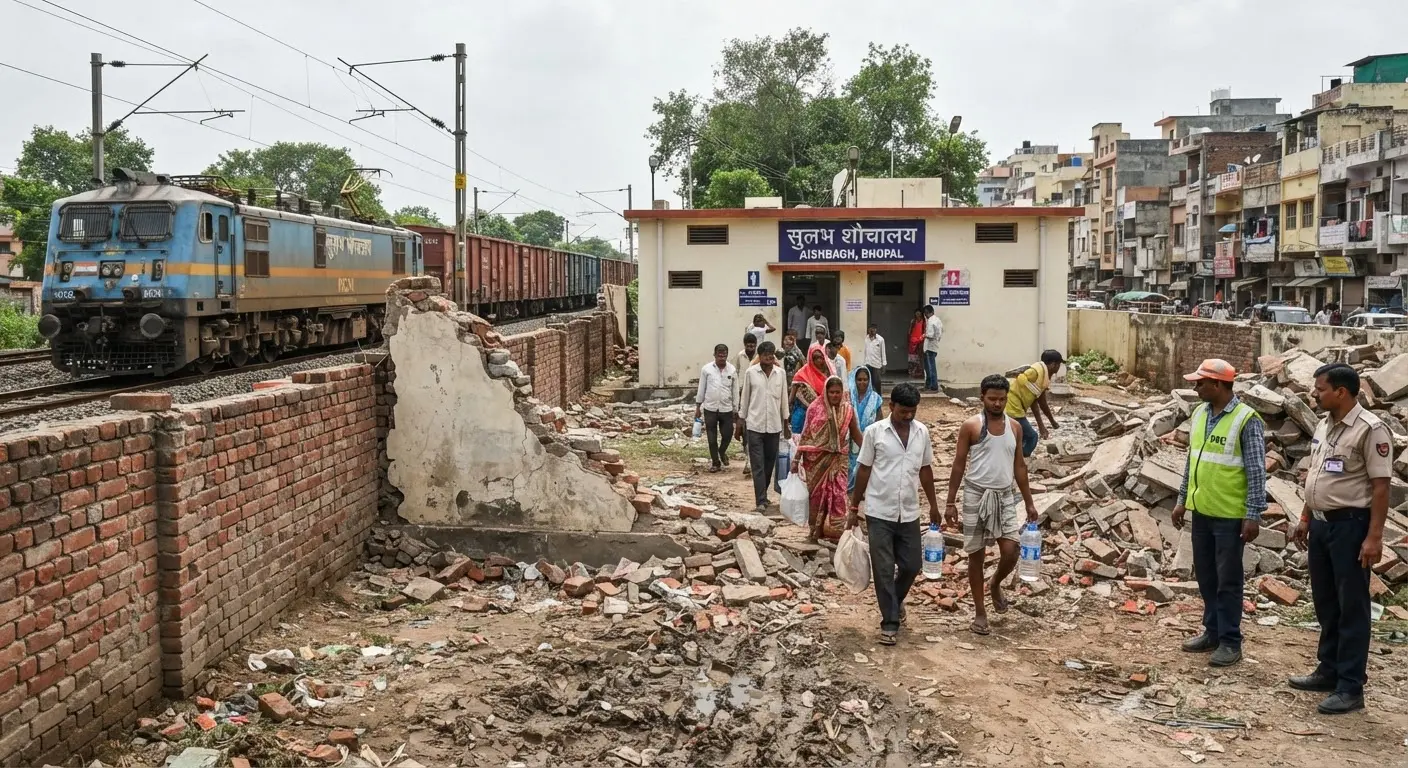

In a move that brings significant relief to the local community, Indian Railways has resolved a long-standing land dispute in Bhopal by removing a boundary wall in the Aishbagh area. This action has effectively restored public access to a municipal toilet facility that had been rendered unusable for months. The resolution follows a period of administrative friction between the West Central Railway (WCR) and the Bhopal Municipal Corporation (BMC) regarding land ownership rights.
- Indian Railways removed the boundary wall in Aishbagh, Bhopal, on Friday to end a prolonged standoff.
- The conflict originated after the Bhopal Municipal Corporation constructed a public toilet on land claimed by both parties.
- The facility, spanning approximately 200 square feet, was previously inaccessible due to the wall erected by the Railways.
- The dispute involved land parcels identified as Kh. No. 1081(5) and 1082(5), totaling 0.1290 hectares.
Understanding the Dispute
The controversy began when the Bhopal Municipal Corporation proceeded with the construction of a public toilet despite early warnings from local residents and officials who suggested the land belonged to the Railways. Once the facility was built, the Bhopal Rail Division erected a boundary wall, asserting its ownership of the site. This resulted in a stalemate where public funds invested in the infrastructure were effectively wasted, as the facility remained locked behind the railway perimeter.
Resolution and Land Claims
The Municipal Corporation had previously challenged the Railways’ stance, citing revenue records, Google Maps, and site photographs to support their claim over the 0.1290-hectare plot. They had formally written to the Senior Divisional Engineer of West Central Railway, labeling the railway’s intervention as an act of unauthorized construction and encroachment.
Initially, the Bhopal Rail Division, represented by spokesperson Naval Agarwal, maintained that they would conduct a thorough verification of their land records before taking any physical action. After assessing the site and the legal standing, the Railways decided to remove the obstruction. This pragmatic decision has finally allowed the facility to be opened for public use, ending the public inconvenience and the administrative deadlock that had plagued the Aishbagh neighborhood.