











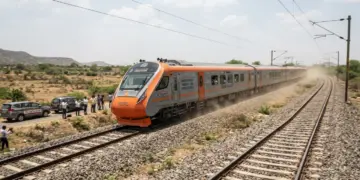

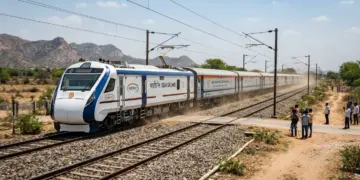
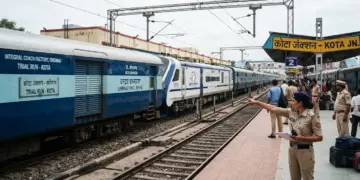




Indian Railways has marked a major milestone in enhancing passenger safety by successfully installing and testing the KAVACH Automatic Train Protection System on the 66-kilometer stretch between Dholpur and Gwalior. Falling under the Jhansi Division of North Central Railway, this section saw a successful locomotive trial conducted on Friday, July 31, 2026, confirming the operational readiness of this indigenous safety technology.
Key highlights of the KAVACH deployment include:
• Successful completion of the loco trial on the 66-km Dholpur-Gwalior section.
• Deployment of the advanced KAVACH SIL-4.0 version to prevent train collisions.
• Expansion plan to cover the entire 321-km Dholpur-Bina route by March 2027.
• Total project investment estimated at 300 crore rupees.
• Installation works executed by HBL Engineering and Shivakriti International Company.
Enhanced Safety Through Advanced Technology
DRM Anirudh Kumar confirmed the success of the trials, noting that the rapid rollout of the standard KAVACH system is a top priority for the national transporter. The system is engineered to act as a safety net, automatically controlling train speeds. If a loco pilot fails to respond to signals or exceeds speed limits, the system automatically triggers alarms and applies brakes to prevent potential mishaps.
The technology relies on a robust infrastructure of LTE towers installed every 10 kilometers along the tracks, facilitating direct communication via radio waves and the internet. Each locomotive is equipped with high-tech components including antennas, AI-based devices, RFID readers, and GNSS (Global Navigation Satellite System) for precise, real-time location tracking. Currently, **150 out of the 300 engines** in the Mandal Railway have already been fitted with these safety devices, with the remaining fleet set to be covered in a phased implementation schedule.
Future Expansion Plans
Building on the success of the Dholpur-Gwalior stretch, Indian Railways is now focusing on the broader **321-kilometer Dholpur-Bina rail corridor**. With a budget allocation of approximately **300 crore rupees**, the project aims to ensure a seamless and safe travel experience for passengers across this critical route. By integrating this indigenous technology, the railways are taking a definitive step toward achieving the goal of ‘zero accidents’ across the network.