










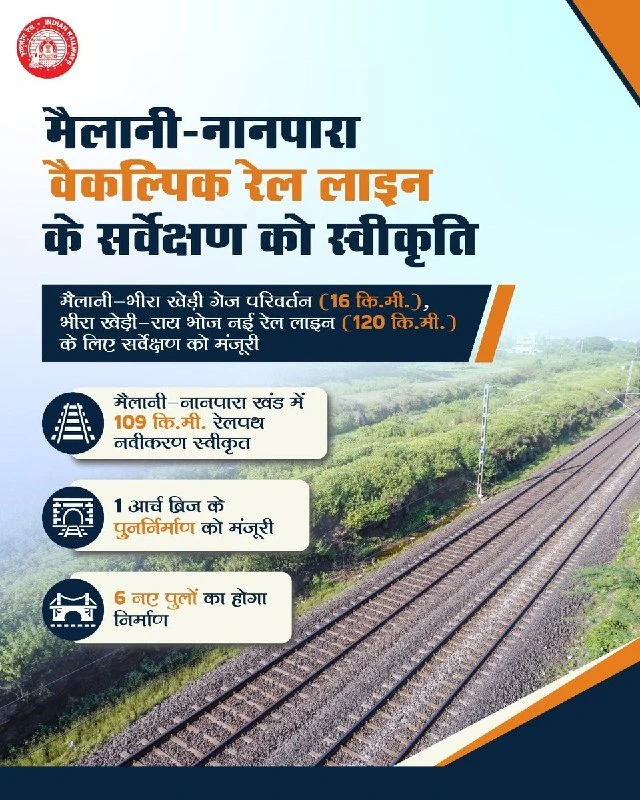

The Ministry of Railways has officially sanctioned a survey for an alternative broad gauge rail line connecting Mailani and Nanpara. This strategic project is designed to enhance connectivity across the Himalayan foothills while providing a seamless transit corridor between the eastern, western, and northern parts of the country, including vital hubs like Delhi, Pilibhit, and Uttarakhand. By creating this alternative route, the railway aims to streamline passenger and freight movement in the region.
Key highlights of the approved rail project include:
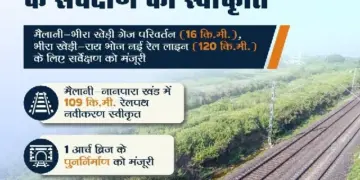
- Final Location Survey (FLS) for a new 120-kilometer rail line between Bhira Kheri and Raibojha.
- Gauge conversion surveys for the 16-kilometer Mailani-Bhira Kheri and 13-kilometer Nanpara-Raibojha sections.
- A total project survey cost of ₹3.58 crore, which includes the preparation of a Detailed Project Report (DPR).
- Strategic alignment of the new line outside the Dudhwa National Park to ensure environmental protection.
Focus on Ecology and Regional Growth
According to Pankaj Kumar Singh, Chief Public Relations Officer of North Eastern Railway (NER), the project is a significant step toward infrastructure development in Uttar Pradesh. By bypassing the sensitive Dudhwa National Park area, the new broad gauge line minimizes ecological impact while maintaining the operational efficiency required for modern rail travel. DRM Gaurav Agarwal of the NER Lucknow division emphasized that the initiative balances the strengthening of existing infrastructure with the preservation of the region’s unique environmental footprint.
Promoting Heritage and Tourism
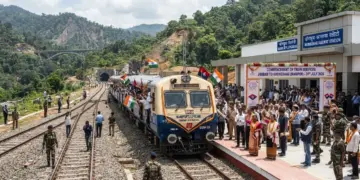
This development complements the existing Mailani-Nanpara meter gauge line, which was declared a heritage route by Indian Railways in October 2025. The railway administration is committed to maintaining this heritage status through track renewals, bridge strengthening, and station retrofitting. Furthermore, the introduction of Vistadome coaches on the heritage route is expected to boost eco-tourism and support the livelihoods of local communities in the Bahraich and Kheri districts. Beyond tourism, the new broad gauge connectivity is slated to play a pivotal role in the efficient transport of agricultural produce, fostering economic growth in these districts. This dual approach of preserving heritage while expanding broad gauge capacity marks a new chapter for rail connectivity in the region.