










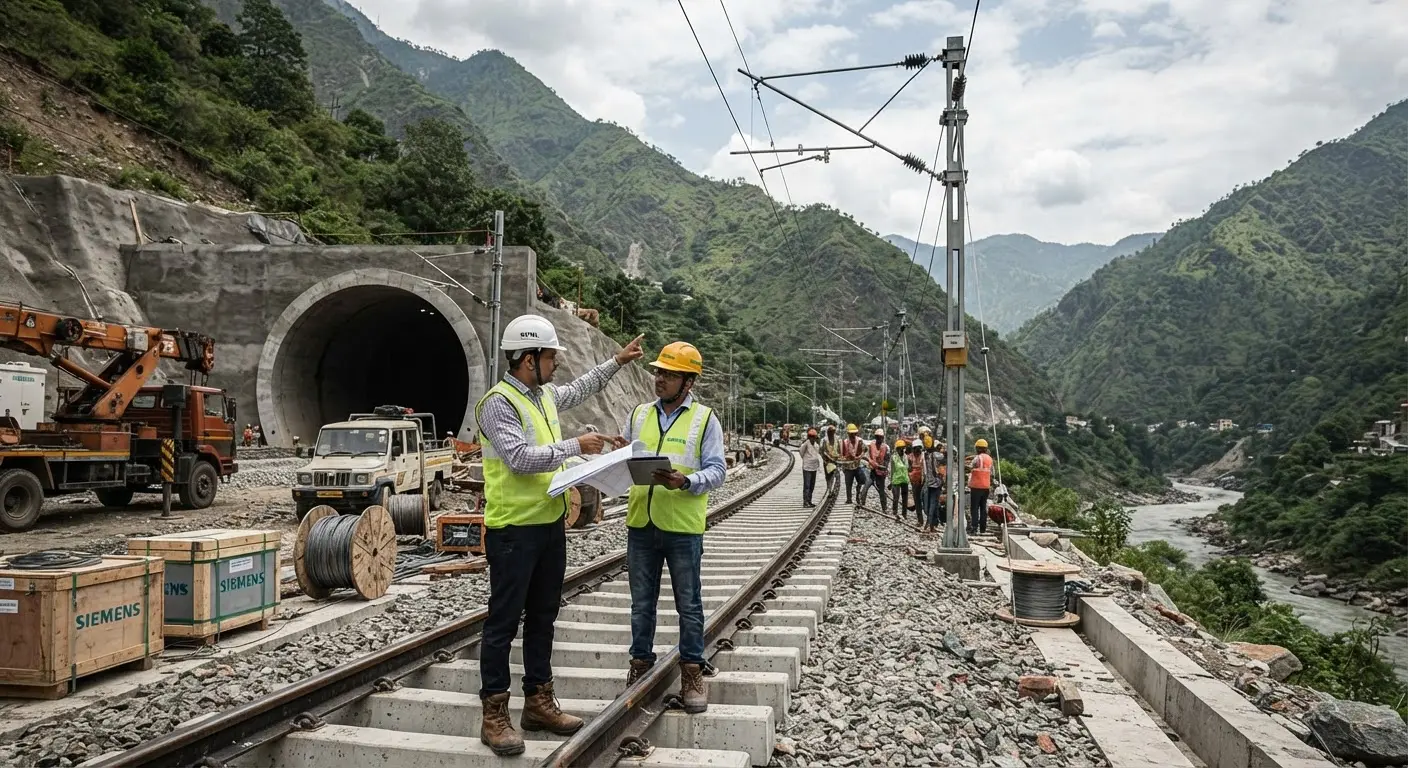

Indian Railways has achieved another major milestone in its ambitious Char Dham project as Siemens Limited secured a contract worth approximately ₹263 crore from Rail Vikas Nigam Limited (RVNL). The project focuses on the electrification of the upcoming Rishikesh-Karnaprayag rail line in Uttarakhand, a critical infrastructure initiative designed to provide seamless, all-weather connectivity to the Himalayan region. The formal announcement regarding this partnership was made on Monday, July 13, 2026.
- Contract Value: Approximately ₹263 crore awarded to Siemens Limited by RVNL.
- Scope of Work: Electrification of 102.5 track kilometers along the 125 km broad-gauge route.
- Technology Involved: Supply and installation of advanced Rigid Overhead Catenary Systems (ROCS) and Flexible Overhead Catenary Systems (FOCS).
- Project Significance: Enhancing all-weather connectivity and reducing travel time to key religious and tourist sites in Uttarakhand.
Engineering in Challenging Himalayan Terrain
The Rishikesh-Karnaprayag line is widely regarded as one of the most challenging engineering feats undertaken by Indian Railways. Because the route traverses difficult Himalayan terrain, nearly 90% of the corridor—over 100 km—is comprised of tunnels. The project includes a massive tunnel stretching nearly 10 kilometers, highlighting the complexity involved in electrifying this mountainous route. The installation of specialized ROCS and FOCS will ensure that the railway line operates with high efficiency and reliability despite the extreme environmental conditions.
Boost to Regional Connectivity and Economy
This electrification project is set to transform travel for both local residents and pilgrims visiting Uttarakhand. By transitioning to a robust, electrified rail network, the region will benefit from reduced travel times and a more sustainable mode of transportation. Mr. Rajeev Joisar, CEO of the Mobility Business at Siemens Limited, noted that this collaboration with RVNL is a significant step toward improving reliable infrastructure in India’s toughest terrains. Beyond simple mobility, the project is expected to act as a catalyst for regional economic development, ensuring that key religious and tourist destinations are more accessible than ever before. As the project progresses, it reinforces the commitment of Indian Railways to modernizing connectivity in the nation’s most remote and vital regions.