











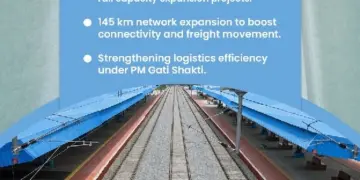













The Cabinet Committee on Economic Affairs (CCEA) has greenlit two major multi-tracking railway projects spanning Odisha and Jharkhand, aimed at significantly bolstering the nation’s freight infrastructure. With a total investment of **₹3,907 crore**, these projects are set to expand the railway network by **145 kilometers** and increase freight handling capacity by **44 Million Tonnes Per Annum (MTPA)**. These initiatives are expected to be fully completed by the **2030-31 fiscal year**.
Key highlights of the approved railway projects include:
- Investment of ₹3,907 crore for multi-tracking infrastructure.
- Addition of 145 kilometers of new railway lines across Odisha and Jharkhand.
- Capacity boost of 44 MTPA for vital commodity transportation.
- Completion timeline set for 2030-31.
- Direct benefit to 14 lakh people across 1,526 villages.
- Significant environmental impact with a reduction of 29 crore kilograms of CO2 emissions.
Strategic Infrastructure Expansion
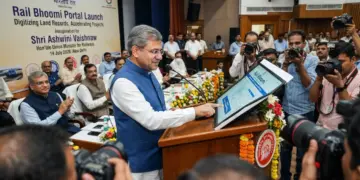
The approved initiatives focus on the doubling of the Paradeep–Haridaspur line and the construction of a fourth line on the Rajkharsawan–Dangoaposi section. According to Union Minister Ashwini Vaishnaw, these additions are essential for easing congestion on routes that serve as the backbone for transporting critical commodities, including coal, iron ore, dolomite, limestone, and gypsum. By integrating these projects into the PM Gati Shakti National Master Plan, the government aims to create a more seamless and efficient logistics network.
Regional Development and Environmental Impact
Beyond operational efficiency, these projects are designed to act as a catalyst for regional growth. The improved rail network will provide better connectivity to major tourist hubs, including the Lalitgiri Buddhist Complex, Shree Baladevjew Temple, and Meghahatuburu Hills.
From an environmental perspective, the shift toward higher rail capacity is expected to yield substantial gains. The government projects an annual reduction of six crore liters in oil imports and a massive decrease in carbon footprint, equivalent to planting one crore trees. Furthermore, these infrastructure works are projected to generate significant employment opportunities, contributing to the vision of a self-reliant or ‘Atmanirbhar’ region. As India continues to modernize its rail network, these projects represent a critical step toward balancing industrial growth with sustainable development.