
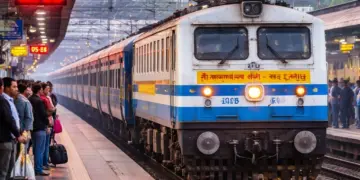

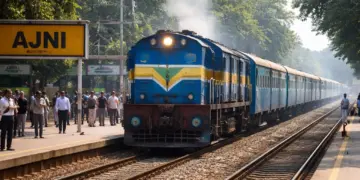



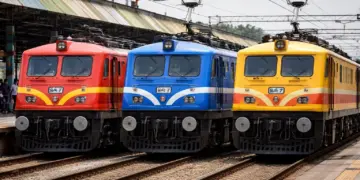












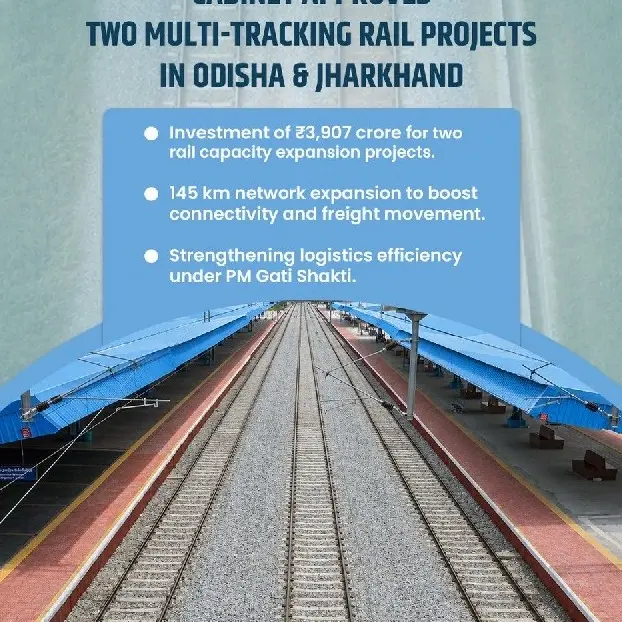

The Union Cabinet has officially approved two major rail infrastructure projects aimed at transforming connectivity across Odisha and Jharkhand. On July 15, 2026, the Cabinet Committee on Economic Affairs, led by Prime Minister Narendra Modi, sanctioned an investment of Rs 3,907 crore to enhance rail capacity and operational efficiency in these states. The initiative focuses on expanding the railway network by approximately 145 kilometers, covering four districts and ensuring smoother transit for both goods and passengers.
Key highlights of the approved rail projects:
- Approval of the Paradeep–Haridaspur rail line doubling and the Rajkharsawan–Dangoaposi fourth line construction.
- Total network expansion of 145 kilometers across Odisha and Jharkhand.
- Expected completion timeline set for 2030-31.
- Projected increase in freight handling capacity by 44 Million Tonnes Per Annum (MTPA).
- Direct connectivity benefits for 1,526 villages and a population of 14 lakh people.
Boosting Freight and Connectivity
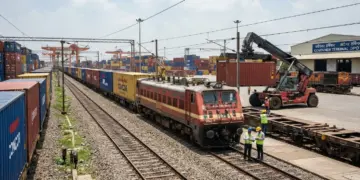
These projects are part of the PM Gati Shakti National Master Plan, which prioritizes integrated infrastructure to streamline logistics. By alleviating congestion on some of the region’s busiest corridors, Indian Railways will be better equipped to transport essential commodities, including coal, iron ore, dolomite, limestone, and gypsum. Beyond industrial benefits, the expansion will provide improved access to significant cultural and tourist landmarks, such as the Lalitgiri Buddhist Complex, the Shree Baladevjew Temple, and the Meghahatuburu Hills.
Environmental and Economic Impact
Beyond the immediate logistical improvements, the government has emphasized the broader socio-economic impact of these rail corridors. The projects are expected to foster local employment and contribute to the vision of a self-reliant India. Furthermore, the infrastructure upgrade carries a significant environmental mandate. Once fully operational, the project is estimated to reduce oil imports by 6 crore liters annually and slash carbon dioxide emissions by nearly 29 crore kg. This environmental contribution is equivalent to the impact of planting 1 crore trees, marking a major step forward in greening the national rail network.