


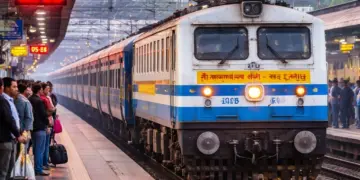

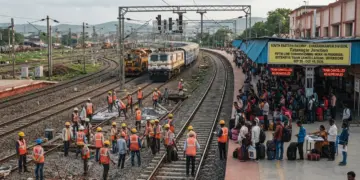






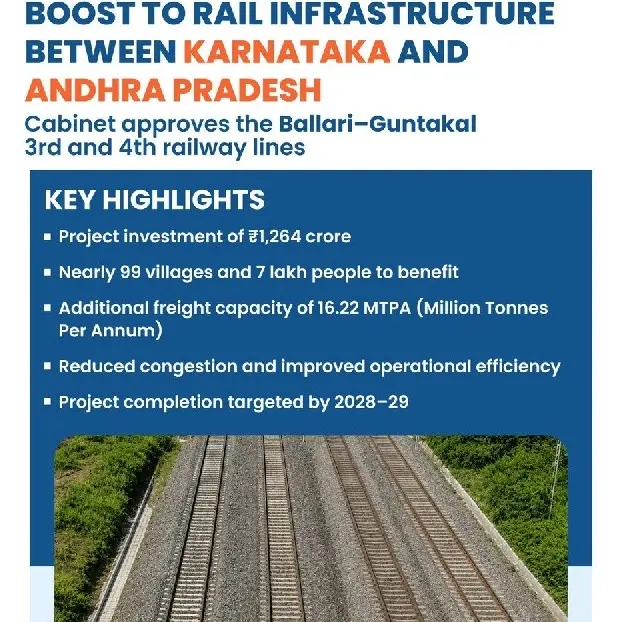

The Cabinet Committee on Economic Affairs, led by Prime Minister Narendra Modi, has officially approved a major multi-tracking project for the Ballari–Guntakal section. This infrastructure boost, valued at ₹1,264 crore, will see the construction of third and fourth railway lines spanning across the states of Karnataka and Andhra Pradesh. The project is scheduled for completion by the 2028-29 fiscal year and will add approximately 46 kilometers to the existing Indian Railways network.
Strategic Connectivity Under PM Gati Shakti
This expansion is a key initiative under the PM Gati Shakti National Master Plan, designed to improve multi-modal connectivity and logistics efficiency. Union Railway Minister Ashwini Vaishnaw highlighted that the Ballari-Guntakal section serves as a crucial economic corridor, linking two major southern states. By increasing rail capacity, the project aims to ensure smoother mobility and faster connectivity for both passengers and freight traffic.
Economic and Social Impact
Beyond simple infrastructure, the project is designed to drive significant economic growth. Indian Railways estimates that the new lines will accommodate an additional 16.22 million tonnes of freight traffic annually. This will streamline the transport of vital commodities, including iron ore, coal, fertilizers, food grains, and steel.
Local communities stand to benefit immensely as well. The expansion will improve connectivity for 99 villages, serving a population of nearly seven lakh people. Furthermore, the project is expected to boost tourism by providing better access to landmarks such as the Ballari Fort and the Sri Kumara Swamy Temple. In terms of local development, the construction phase will generate 31 lakh human-days of employment.
Environmental Sustainability
In line with India’s green energy goals, this project plays a role in reducing the carbon footprint of the transport sector. By shifting more logistics from road to rail, the initiative is projected to save 1.32 crore liters of fuel and reduce CO2 emissions by approximately 6.67 crore kg. This shift not only eases congestion on highways but also makes the movement of goods significantly more efficient and environmentally friendly.