










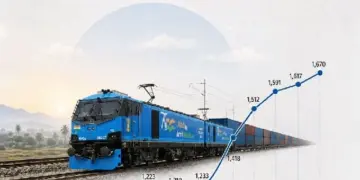








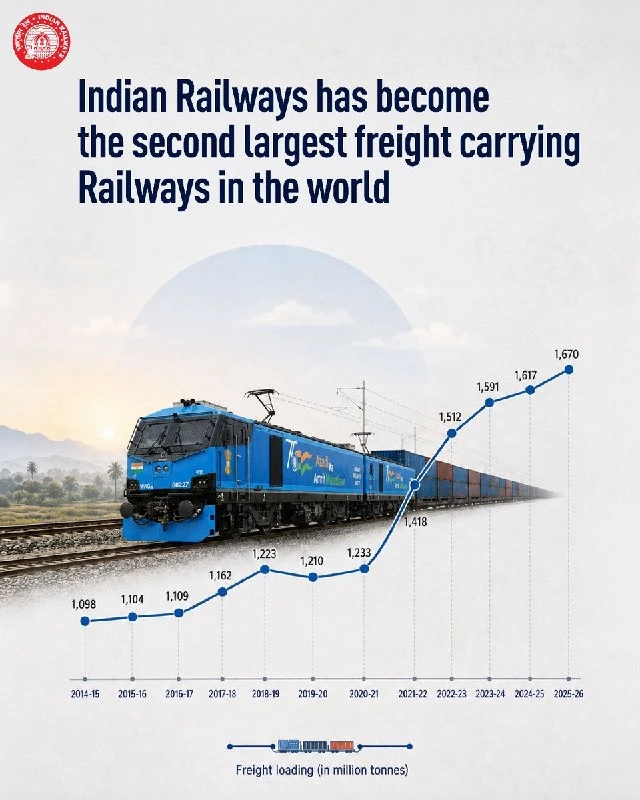

Indian Railways has reached a historic global milestone, officially becoming the world’s second-largest freight-carrying network as of August 7, 2026. This achievement reflects the nation’s rapidly expanding logistics capabilities and the increasing efficiency of its rail infrastructure. Union Minister for Railways, Ashwini Vaishnaw, confirmed this feat in the Rajya Sabha, highlighting that the national transporter successfully increased its freight loading to 1,670 Million Tonnes (MT) during the 2025-26 fiscal year.
- Global Ranking: Indian Railways is now the second-largest freight network worldwide.
- Record Loading: Annual freight loading reached an impressive 1,670 MT in 2025-26.
- Gati Shakti Terminals: 142 GCTs commissioned with a capacity of 224 MTPA.
- Private Investment: Over ₹10,000 crore mobilized through private sector participation.
- New Corridor: A new DFC project connecting Dankuni to Surat is currently in the works.
Strategic Growth and Infrastructure
The Ministry of Railways has adopted a multi-pronged strategy to streamline logistics and boost regional connectivity. A cornerstone of this success is the full-scale operation of Dedicated Freight Corridors (DFC) and the aggressive expansion of Gati Shakti Multi-Modal Cargo Terminals (GCTs). The GCT policy has been a game-changer, attracting approximately ₹10,000 crore in private investment and facilitating the handling of 146 MT of freight in the last fiscal year alone.
To support this growth, the government has incentivized private sector investment in rolling stock. This initiative has led to the induction of 275 rakes of special purpose wagons and 397 rakes of other wagons, significantly expanding the capacity to move goods across the country.
Future Expansion and Performance
Looking ahead, the Union Budget 2026 has paved the way for a new corridor linking Dankuni in the East to Surat in the West. This strategic link is designed to prioritize Double Stack Container (DSC) trains, ensuring smoother connectivity between Western ports and the northern hinterlands. The impact of these improvements is already visible, with Indian Railways recording a 9% year-on-year growth in freight loading in July 2026, moving 141.3 million tonnes. As demand continues to rise across key industrial sectors, these infrastructure investments are set to keep India’s economy moving at full speed.