















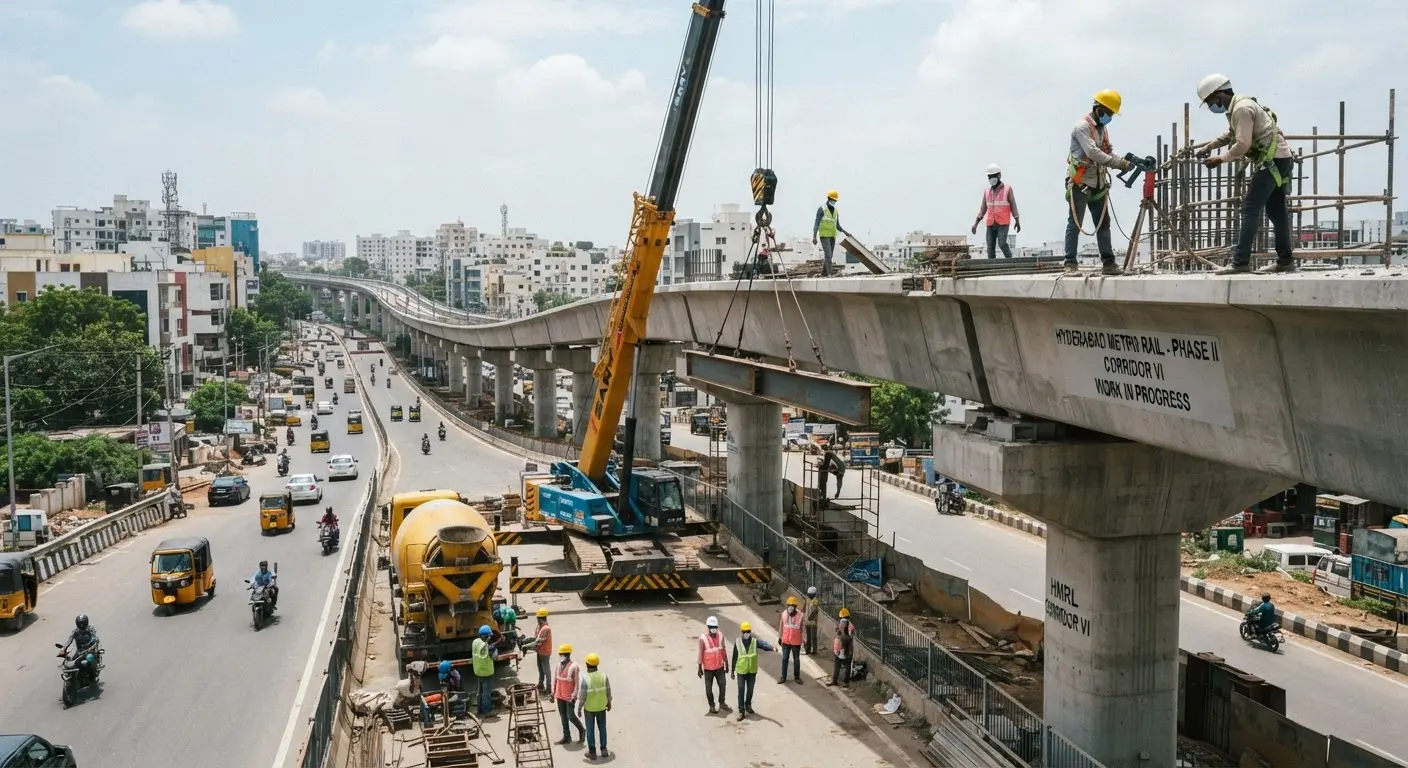

The expansion of the Hyderabad Metro Rail network has received a major boost as the Supreme Court of India dismissed a special leave petition that sought to halt construction on the Phase-II Corridor VI. This legal development, finalized on June 2, 2026, removes a significant hurdle for the 7.5-kilometer stretch connecting Mahatma Gandhi Bus Station (MGBS) to Chandrayangutta.
- The Supreme Court dismissed the stay petition on June 2, 2026, allowing work to proceed on the ₹2,886-crore project.
- Land acquisition is nearly complete, with 90% of required properties secured as of May 14, 2026.
- HMRL expects to resolve remaining property disputes near Darulshifa by the end of June 2026.
- The Telangana government has committed to obtaining all statutory approvals before working in heritage-sensitive areas.
Progress on Land Acquisition
With the legal clearance, Hyderabad Metro Rail Ltd (HMRL) is moving quickly to wrap up the land acquisition process. Currently, 90% of the necessary land has been acquired. The remaining acquisition efforts are focused on 10 to 15 disputed properties located near Darulshifa. Officials are confident that these final hurdles will be cleared by the end of June 2026, paving the way for seamless construction along the Old City route.
Commitment to Heritage Preservation
Project development in the historic parts of Hyderabad has been subject to intense scrutiny to ensure the city’s architectural legacy remains intact. On August 5, 2026, the Telangana High Court received formal assurances from the state government that all necessary statutory approvals will be secured before any construction activity begins in heritage-sensitive zones.
This follows previous directives from November 7, 2025, which mandated the submission of official alignment drawings through sensitive precincts such as Charminar and Falaknuma. While a Public Interest Litigation (PIL) was filed to halt work due to concerns over the lack of a Heritage Impact Assessment, the Additional Advocate General has clarified that no declared archaeological structures will be disturbed or demolished without proper authorization. The High Court continues to monitor the situation, with the next hearing scheduled for August 27, 2026. This project remains a critical infrastructure initiative aimed at improving connectivity in the heart of the city while balancing modern transit needs with historical conservation.