
















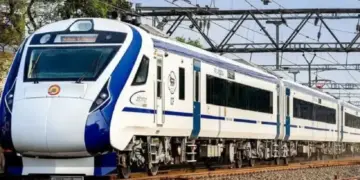





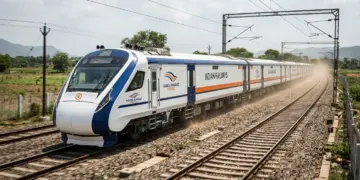


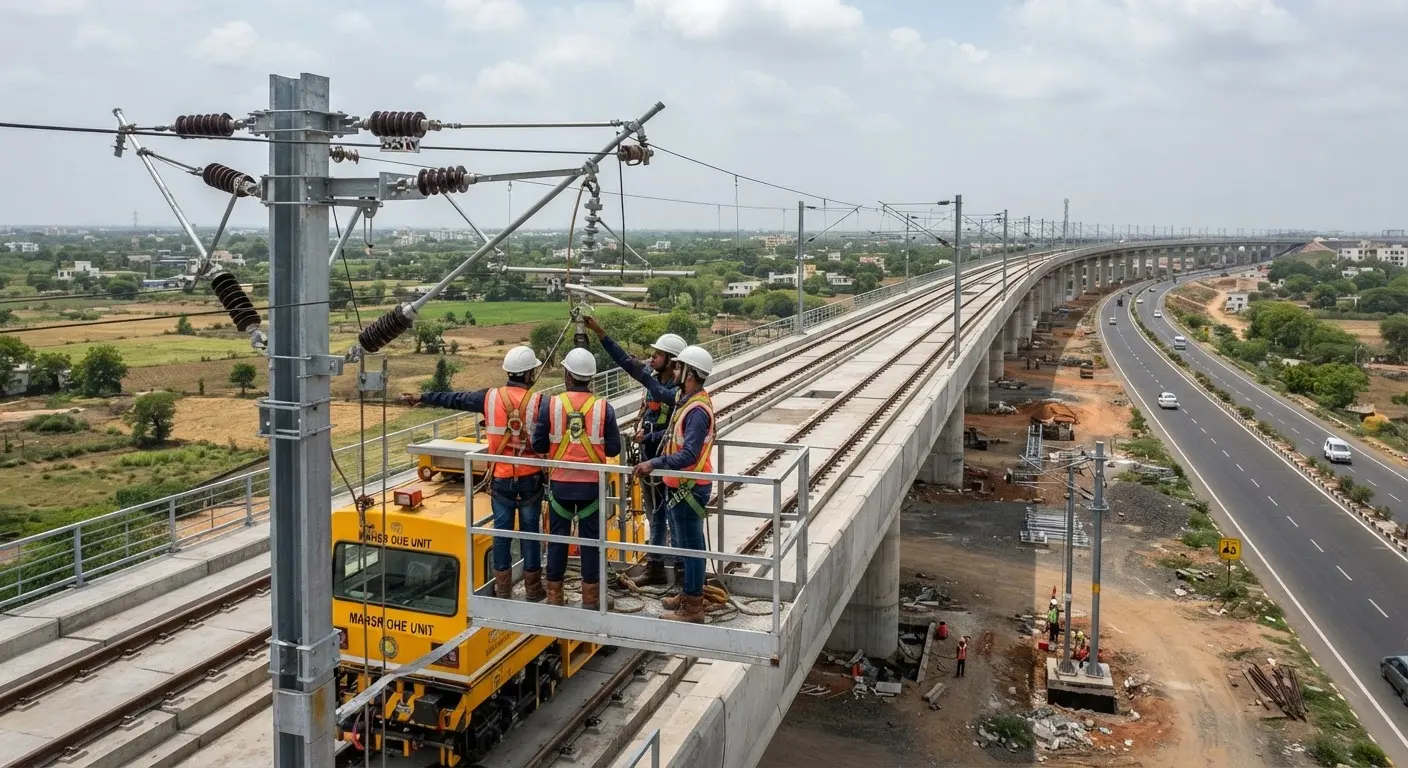

The Mumbai-Ahmedabad High-Speed Rail (MAHSR) project has achieved a major technical milestone by implementing India’s first 2×25 kV overhead traction system. This state-of-the-art electrification technology is essential for enabling the bullet train to operate at its design speed of 320 kmph. By ensuring a stable and uninterrupted power supply, the National High Speed Rail Corporation Ltd. (NHSRCL) is laying the groundwork for world-class high-speed rail travel in India.
- Advanced 2×25 kV traction system designed to support speeds up to 320 kmph.
- Infrastructure includes 14 Traction Substations and 31 Switching Posts.
- Key electrical components manufactured in India under the Make in India initiative.
- Safety network features 28 earthquake detection seismometers to halt trains during tremors.
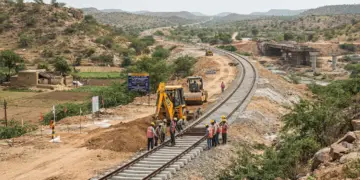
- The project covers 1,125 track kilometres using 22,000 steel masts.
Engineering the Power Grid
The 2×25 kV system works by transmitting electricity at 50 kV between the overhead line and a feeder transmission line, subsequently stepping it down to 25 kV for the train via its pantograph. This configuration is highly efficient, as it reduces energy losses and allows for greater spacing between substations. The power is sourced directly from the National Power Grid, ensuring reliability. The contract for these complex electrical works was awarded to a consortium comprising Larsen & Toubro (L&T) and Sojitz Corp.
Precision and Safety Standards
To maintain high-speed operations, the overhead wires are installed with precise mechanical tension. This ensures that the train’s pantograph maintains smooth and continuous contact with the wire, preventing power fluctuations or sparks that could occur at 320 kmph. The scale of the project is immense, featuring over 25,700 cantilever assemblies across the entire corridor.
Beyond performance, safety remains a top priority. The entire electrical network is managed by a centralised control system that monitors power distribution in real-time. Furthermore, the integration of 28 earthquake detection seismometers linked to the substations provides an automated safety layer, capable of bringing the train to a halt if seismic activity is detected. By blending Japanese Shinkansen technology with domestic manufacturing prowess, the MAHSR project is setting a new benchmark for railway infrastructure in India.