








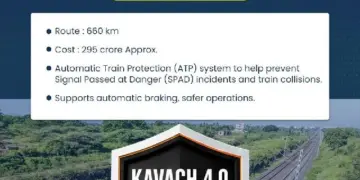









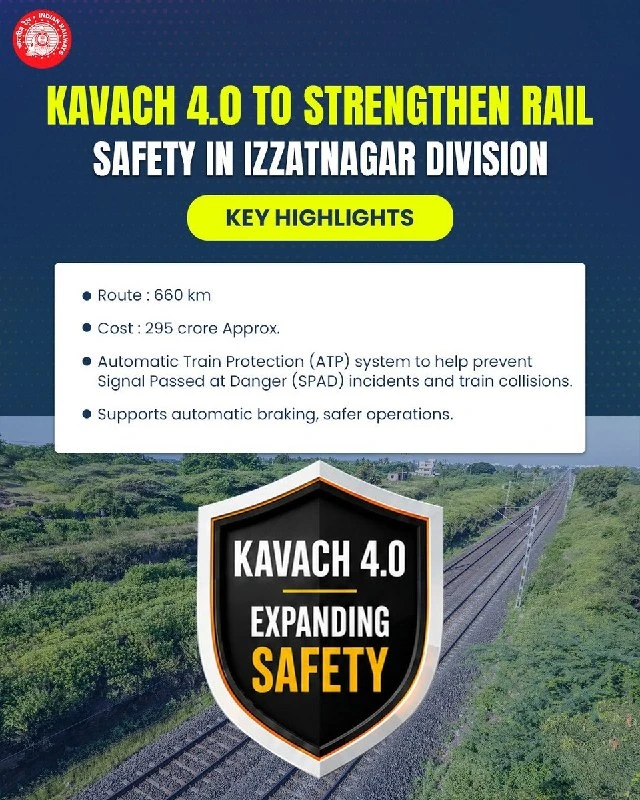

The Ministry of Railways has officially launched the expansion of its indigenous Automatic Train Protection (ATP) system, Kavach 4.0, across the North Eastern Railway’s Izzatnagar Division. This significant infrastructure project aims to bolster passenger safety through advanced technological intervention. The initiative covers a total of 660 route kilometers and has been sanctioned at an estimated cost of ₹295 crore. The deployment focuses on critical connectivity routes, specifically spanning the Kasganj-Izzatnagar, Izzatnagar-Kathgodam, and Bhojipura-Tanakpur sections, encompassing a total of 53 railway stations.
Understanding Kavach 4.0 Safety Technology
Kavach 4.0 serves as a robust shield against human error and operational hazards. The system is specifically engineered to prevent Signal Passed at Danger (SPAD) incidents and avert potential train collisions. By providing continuous movement monitoring, the system remains vigilant at all times. If a locomotive pilot fails to control the train within prescribed limits, the system automatically engages the brakes to ensure a safe stop. Furthermore, this version offers enhanced operational reliability, providing consistent performance even during challenging weather conditions such as dense fog, which often impacts visibility and train operations in North India.
Expanding the National Safety Network
This latest move in the Izzatnagar Division is part of a larger, nationwide effort to modernize the Indian Railways’ safety architecture. Kavach technology has already been successfully commissioned across 1,452 route kilometers. Previous implementations have targeted the country’s busiest high-density corridors, most notably the Delhi–Mumbai and Delhi–Howrah routes. By scaling this indigenous solution, the Ministry of Railways is moving closer to its goal of creating a ‘zero-accident’ network, ensuring that millions of daily commuters experience safer and more reliable rail travel across the country.